
Toll-like receptors (TLRs) act to: a. Bind microbial proteins and polysaccharides b. Induce phagocytosis c. Cause phagocytic chemotaxis d. Destroy microbial cells
Verified step by step guidance
1
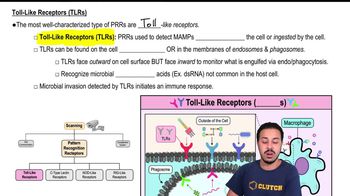
Step 1: Understand the role of Toll-like receptors (TLRs) in the immune system. TLRs are a class of proteins that recognize specific molecular patterns commonly found on pathogens, such as microbial proteins and polysaccharides.
Step 2: Recognize that TLRs function primarily as pattern recognition receptors (PRRs) that detect pathogen-associated molecular patterns (PAMPs) to initiate immune responses.
Step 3: Know that upon binding to microbial components, TLRs trigger intracellular signaling pathways that lead to the activation of immune cells and the production of cytokines, but they do not directly induce phagocytosis or destroy microbes themselves.
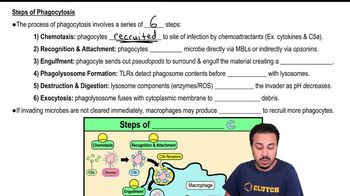
Step 4: Differentiate TLR functions from other immune mechanisms: while TLRs recognize microbes, phagocytosis and chemotaxis are processes carried out by immune cells like macrophages and neutrophils, often activated downstream of TLR signaling.
Step 5: Conclude that the primary action of TLRs is to bind microbial proteins and polysaccharides, which corresponds to option (a).
Verified video answer for a similar problem:
This video solution was recommended by our tutors as helpful for the problem above
Video duration:
3m
Play a video:
0 Comments
Key Concepts
Here are the essential concepts you must grasp in order to answer the question correctly.
Toll-like Receptors (TLRs)
TLRs are pattern recognition receptors on immune cells that detect conserved microbial molecules like proteins and polysaccharides. They play a crucial role in recognizing pathogens and initiating immune responses by activating signaling pathways.
Upon binding microbial components, TLRs trigger intracellular signaling that leads to the production of cytokines and other mediators. This activation helps coordinate the immune response but does not directly cause phagocytosis or microbial destruction.
Phagocytosis is the process where immune cells engulf and destroy microbes, often guided by chemotaxis, the movement toward chemical signals. While TLR activation can enhance these processes indirectly, TLRs themselves do not directly induce phagocytosis or chemotactic movement.