
What is the role of Toll-like receptors in innate immune responses?
Verified step by step guidance
1
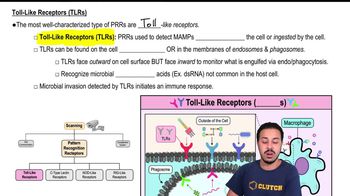
Understand that Toll-like receptors (TLRs) are a class of proteins that play a critical role in the innate immune system by recognizing molecules that are broadly shared by pathogens but distinguishable from host molecules.
Recognize that TLRs are pattern recognition receptors (PRRs) located on the surface or within immune cells such as macrophages and dendritic cells, enabling these cells to detect pathogen-associated molecular patterns (PAMPs).
Identify that upon binding to PAMPs, TLRs initiate intracellular signaling cascades that lead to the activation of transcription factors like NF-\(\Gamma\) B, which promote the expression of genes involved in inflammatory responses.
Note that the activation of TLRs results in the production of cytokines, chemokines, and other mediators that help recruit and activate additional immune cells, thereby enhancing the innate immune response and shaping the adaptive immune response.
Summarize that the overall role of TLRs is to serve as sentinels that detect invading pathogens early and trigger immediate defense mechanisms to contain infections and alert the adaptive immune system.
Verified video answer for a similar problem:
This video solution was recommended by our tutors as helpful for the problem above
Video duration:
2m
Play a video:
0 Comments
Key Concepts
Here are the essential concepts you must grasp in order to answer the question correctly.
Toll-like Receptors (TLRs)
Toll-like receptors are a class of proteins found on immune cells that recognize specific molecular patterns commonly present on pathogens. They act as sensors to detect microbial components like lipopolysaccharides or viral RNA, initiating immune responses.
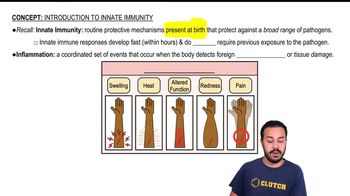
The innate immune response is the body's first line of defense against infections, providing a rapid but non-specific reaction to pathogens. It involves physical barriers, immune cells, and molecular mechanisms that recognize and respond to common microbial features.
Upon recognizing pathogens, TLRs trigger intracellular signaling pathways that activate transcription factors, leading to the production of cytokines and chemokines. These molecules coordinate inflammation and recruit other immune cells to eliminate the infection.