
Which of the following is not targeted by a Toll-like receptor? a. Lipid A b. Eukaryotic flagellar protein c. Single-stranded RNA d. Lipoteichoic acid
Verified step by step guidance
1
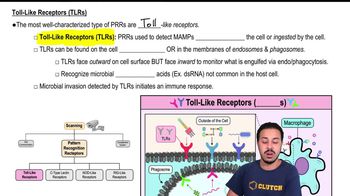
Step 1: Understand the role of Toll-like receptors (TLRs). TLRs are a class of proteins that recognize pathogen-associated molecular patterns (PAMPs) found on microbes, triggering an immune response.
Step 2: Identify common targets of TLRs. For example, TLR4 recognizes Lipid A (a component of lipopolysaccharide in Gram-negative bacteria), TLR2 recognizes lipoteichoic acid (from Gram-positive bacteria), and TLR7/8 recognize single-stranded RNA (common in viruses).
Step 3: Analyze each option in the question: (a) Lipid A is recognized by TLR4, (b) Eukaryotic flagellar protein is a protein from eukaryotes, not bacteria, so it is generally not recognized by TLRs, (c) Single-stranded RNA is recognized by TLR7/8, (d) Lipoteichoic acid is recognized by TLR2.
Step 4: Recall that TLRs primarily recognize microbial components, not eukaryotic proteins, so eukaryotic flagellar protein is not a target of TLRs.
Step 5: Conclude that the correct answer is the option that is not targeted by TLRs, which is the eukaryotic flagellar protein.
Verified video answer for a similar problem:
This video solution was recommended by our tutors as helpful for the problem above
Video duration:
2m
Play a video:
0 Comments
Key Concepts
Here are the essential concepts you must grasp in order to answer the question correctly.
Toll-like Receptors (TLRs) and Their Function
TLRs are pattern recognition receptors in the innate immune system that detect conserved microbial molecules called pathogen-associated molecular patterns (PAMPs). They initiate immune responses by recognizing components like bacterial lipids, nucleic acids, and proteins, helping the body distinguish pathogens from self.
Different TLRs recognize specific microbial molecules: TLR4 detects Lipid A from Gram-negative bacteria; TLR2 recognizes lipoteichoic acid from Gram-positive bacteria; TLR7 and TLR8 detect single-stranded RNA from viruses. These interactions trigger signaling pathways to activate immune defenses.
Distinction Between Prokaryotic and Eukaryotic Flagellar Proteins
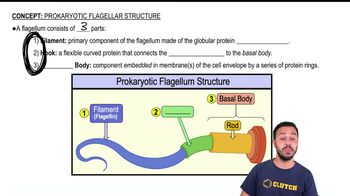
Bacterial flagella are made of flagellin, a protein recognized by TLR5, whereas eukaryotic flagella have a different structure and protein composition. TLRs do not target eukaryotic flagellar proteins because they are not microbial PAMPs, thus preventing immune responses against host or non-pathogenic eukaryotic cells.