
Textbook Question
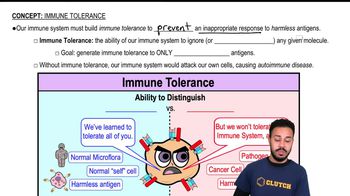
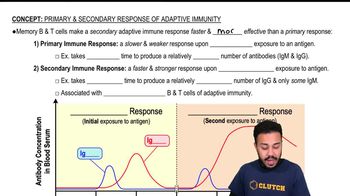
How would each of the following prevent infection?
a. Antibodies against Neisseria gonorrhoeae fimbriae
b. Antibodies against host cell mannose
1537
views

 Verified step by step guidance
 03:19
03:19
 06:59
06:59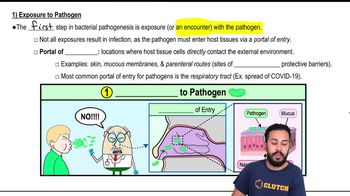 03:27
03:27How would each of the following prevent infection?
a. Antibodies against Neisseria gonorrhoeae fimbriae
b. Antibodies against host cell mannose
How can a human make 100 billion different antibodies with only 25,000 different genes?
Match the following choices to the statements in questions 5–7:
a. IgA
b. IgD
c. IgE
d. IgG
e. IgM
The first antibodies synthesized; especially effective against microorganisms.
A kidney-transplant patient experienced a cytotoxic rejection of the new kidney. Place the following in order for that rejection:
(1) apoptosis occurs
(2) CD8⁺ T cell becomes CTL
(3) granzymes released
(4) MHC class I activates CD8⁺ T cell
(5) perforin released
a. 1, 2, 3, 4, 5
b. 5, 4, 3, 2, 1
c. 4, 2, 5, 3, 1
d. 3, 4, 5, 1, 2
e. 2, 3, 4, 1, 5
Match the following choices to the statements in questions 5–7:
a. IgA
b. IgD
c. IgE
d. IgG
e. IgM
Antibodies that are bound to mast cells and involved in allergic reactions.
Put the following in the correct sequence to elicit an antibody response:
(1) TH cell produces cytokines
(2) B cell contacts antigen
(3) antigen fragment goes to surface of the B cell
(4) TH recognizes antigen fragment and MHC
(5) B cell proliferates.
a. 1, 2, 3, 4, 5
b. 5, 4, 3, 2, 1
c. 3, 4, 5, 1, 2
d. 2, 3, 4, 1, 5
e. 4, 5, 3, 1, 2