Ch. 17 - Adaptive Immunity: Specific Defenses of the Host
Tortora - Microbiology: An Introduction 14th Edition
Tortora14th EditionMicrobiology: An IntroductionISBN: 9780138200398Not the one you use?Change textbook
Chapter 17, Problem 6

Match the following choices to the statements in questions 5–7:
a. IgA
b. IgD
c. IgE
d. IgG
e. IgM
The first antibodies synthesized; especially effective against microorganisms.

Verified step by step guidance
1
Understand that the question asks to identify which immunoglobulin (antibody) class corresponds to the description: 'The first antibodies synthesized; especially effective against microorganisms.'
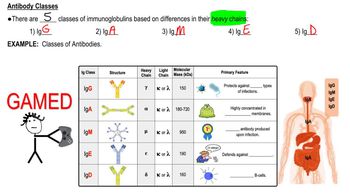
Recall the main functions and characteristics of the immunoglobulin classes: IgA, IgD, IgE, IgG, and IgM.
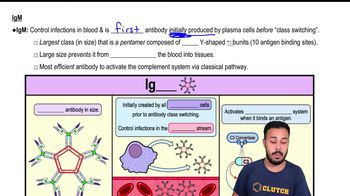
Focus on the fact that the 'first antibodies synthesized' during an immune response are typically IgM antibodies, which are produced early and are effective in agglutination and complement activation.
Recognize that IgM is a pentamer, which allows it to bind effectively to microorganisms and initiate immune defense.
Match the description to the correct antibody class: IgM.

Verified video answer for a similar problem:

This video solution was recommended by our tutors as helpful for the problem above.
Video duration:
2m
Was this helpful?

Key Concepts

Here are the essential concepts you must grasp in order to answer the question correctly.

Antibody Classes (Immunoglobulins)

Antibodies, or immunoglobulins, are proteins produced by B cells that recognize specific antigens. There are five main classes—IgA, IgD, IgE, IgG, and IgM—each with distinct roles in immune defense and distribution in the body.
Recommended video:
Guided course
04:43
Classes of Antibodies

IgM as the First Antibody Produced

IgM is the first antibody class synthesized during an initial immune response. It is especially effective against microorganisms due to its pentameric structure, which allows strong binding and efficient activation of the complement system.
Recommended video:

Role of Antibodies in Microbial Defense

Antibodies neutralize pathogens by binding to antigens, preventing infection and marking microbes for destruction. Different antibody classes specialize in various defense mechanisms, such as mucosal immunity (IgA) or allergic responses (IgE).
Recommended video: