
Textbook Question
How would each of the following prevent infection?
a. Antibodies against Neisseria gonorrhoeae fimbriae
b. Antibodies against host cell mannose
1537
views
 Verified step by step guidance
 03:21
03:21
 04:43
04:43How would each of the following prevent infection?
a. Antibodies against Neisseria gonorrhoeae fimbriae
b. Antibodies against host cell mannose
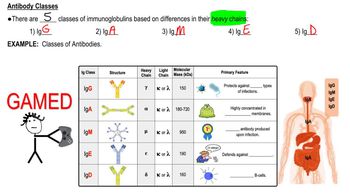
Match the following choices to the statements in questions 5–7:
a. IgA
b. IgD
c. IgE
d. IgG
e. IgM
The first antibodies synthesized; especially effective against microorganisms.
a. In the following graph, at time A the host was injected with tetanus toxoid. Show the response to a booster dose at time B.
b. Draw the antibody response of this same individual to exposure to a new antigen at time B.
Explain why a person who recovers from a disease can attend others with the disease without fear of contracting it.
Put the following in the correct sequence to elicit an antibody response:
(1) TH cell produces cytokines
(2) B cell contacts antigen
(3) antigen fragment goes to surface of the B cell
(4) TH recognizes antigen fragment and MHC
(5) B cell proliferates.
a. 1, 2, 3, 4, 5
b. 5, 4, 3, 2, 1
c. 3, 4, 5, 1, 2
d. 2, 3, 4, 1, 5
e. 4, 5, 3, 1, 2
Explain a function for the following types of cells: CTL, TH, and Treg. What is a cytokine?