Ch. 3 - Cell Structure and Function
Bauman - Microbiology with Diseases by Taxonomy 6th Edition
Bauman6th EditionMicrobiology with Diseases by TaxonomyISBN: 9780134832302Not the one you use?Change textbook
Chapter 3, Problem 7

Which of the following statements is true?


a. The cell walls of bacteria are composed of peptidoglycan.
b. Peptidoglycan is a fatty acid.
c. Gram-positive bacterial walls have a relatively thin layer of peptidoglycan anchored to the cytoplasmic membrane by teichoic acids.
d. Peptidoglycan is found mainly in the cell walls of fungi, algae, and plants.

Verified step by step guidance
1
Step 1: Understand the composition of bacterial cell walls. Bacterial cell walls are primarily made of a polymer called peptidoglycan, which provides structural strength and shape to the cell.
Step 2: Clarify what peptidoglycan is chemically. Peptidoglycan is not a fatty acid; it is a complex polymer consisting of sugars and amino acids forming a mesh-like layer outside the plasma membrane.
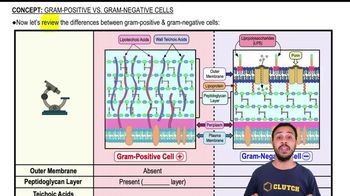
Step 3: Differentiate between Gram-positive and Gram-negative bacterial cell walls. Gram-positive bacteria have a thick peptidoglycan layer, whereas Gram-negative bacteria have a thinner peptidoglycan layer and an outer membrane.
Step 4: Understand the role of teichoic acids. In Gram-positive bacteria, teichoic acids are molecules that anchor the thick peptidoglycan layer to the cytoplasmic membrane and contribute to cell wall maintenance and ion regulation.
Step 5: Recognize where peptidoglycan is found. Peptidoglycan is unique to bacterial cell walls and is not found in the cell walls of fungi, algae, or plants, which have other structural components like chitin or cellulose.

Verified video answer for a similar problem:

This video solution was recommended by our tutors as helpful for the problem above.
Video duration:
3m
Was this helpful?

Key Concepts

Here are the essential concepts you must grasp in order to answer the question correctly.

Structure and Composition of Bacterial Cell Walls

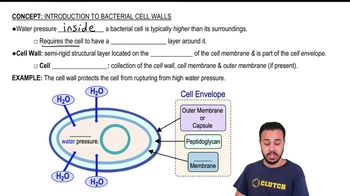
Bacterial cell walls are primarily composed of peptidoglycan, a polymer consisting of sugars and amino acids that provides structural support and shape. This layer is essential for bacterial survival and differs between Gram-positive and Gram-negative bacteria.
Recommended video:
Guided course
03:44
Introduction to Bacterial Cell Walls

Differences Between Gram-Positive and Gram-Negative Bacteria

Gram-positive bacteria have a thick peptidoglycan layer containing teichoic acids that anchor it to the cytoplasmic membrane, while Gram-negative bacteria have a thinner peptidoglycan layer located between the inner and outer membranes. These differences affect staining properties and antibiotic susceptibility.
Recommended video:
Guided course
04:46
Gram-Positive vs. Gram-Negative Cell Walls

Composition of Peptidoglycan

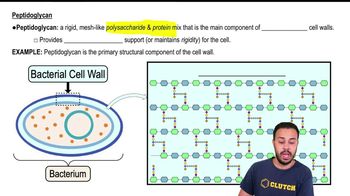
Peptidoglycan is not a fatty acid but a complex polymer made of sugar chains cross-linked by short peptides. It is unique to bacterial cell walls and is absent in fungi, algae, and plants, which have cell walls made of chitin, cellulose, or other polysaccharides.
Recommended video:
Guided course
01:58
Peptidoglycan