Ch. 3 - Cell Structure and Function
Bauman - Microbiology with Diseases by Taxonomy 6th Edition
Bauman6th EditionMicrobiology with Diseases by TaxonomyISBN: 9780134832302Not the one you use?Change textbook
Chapter 3, Problem 5

Which of the following is not associated with prokaryotic organisms?


a. Nucleoid
b. Glycocalyx
c. Cilia
d. Circular DNA

Verified step by step guidance
1
Step 1: Understand the characteristics of prokaryotic cells. Prokaryotes are unicellular organisms that lack a membrane-bound nucleus and other membrane-bound organelles.
Step 2: Review each option and determine if it is typically found in prokaryotic cells. For example, the nucleoid is the region in prokaryotes where their circular DNA is located, so it is associated with prokaryotes.
Step 3: Consider the glycocalyx, which is a sticky outer layer found in many prokaryotes that helps in protection and adherence, so it is also associated with prokaryotes.
Step 4: Examine the presence of cilia. Cilia are hair-like structures used for movement or sensory functions and are characteristic of eukaryotic cells, not prokaryotes.
Step 5: Confirm that circular DNA is typical of prokaryotes, as their genetic material is usually a single circular chromosome, unlike the linear chromosomes in eukaryotes.

Verified video answer for a similar problem:

This video solution was recommended by our tutors as helpful for the problem above.
Video duration:
1m
Was this helpful?

Key Concepts

Here are the essential concepts you must grasp in order to answer the question correctly.

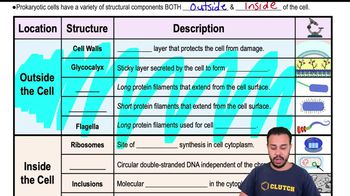
Prokaryotic Cell Structure

Prokaryotic cells lack a true nucleus and instead have a nucleoid region where their circular DNA is located. They have simpler internal structures compared to eukaryotes and lack membrane-bound organelles.
Recommended video:
Guided course
05:59
Overview of Prokaryotic Cell Structure

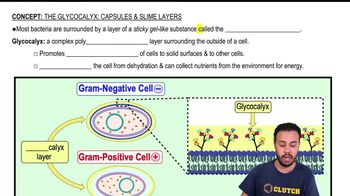
Glycocalyx in Prokaryotes

The glycocalyx is a sticky, gelatinous layer surrounding some prokaryotic cells, aiding in protection and adherence to surfaces. It can exist as a capsule or slime layer and is important for bacterial virulence.
Recommended video:
Guided course
02:26
The Glycocalyx: Capsules & Slime Layers

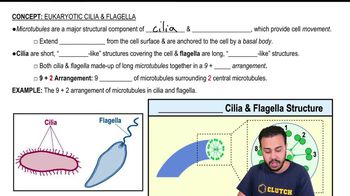
Cilia and Flagella Differences

Cilia are short, hair-like structures found mainly on eukaryotic cells for movement or sensory functions. Prokaryotes do not have cilia but may have flagella, which are longer and structurally different, used for motility.
Recommended video:
Guided course
02:36
Eukaryotic Cilia & Flagella
Related Practice
Textbook Question

What is the difference between growth and reproduction?

972
views

Textbook Question

Which of the following is true of Svedbergs?


a. They are not exact but are useful for comparisons.

b. They are abbreviated “sv.”

c. They are prokaryotic in nature but exhibit some eukaryotic characteristics.

d. They are an expression of sedimentation rate during high-speed centrifugation.

1646
views
Textbook Question

Which of the following is most associated with diffusion?


a. Symports

b. Antiports

c. Carrier proteins

d. Endocytosis

1297
views
Textbook Question

A local newspaper writer has contacted you, an educated microbiology student from a respected college. He wants to obtain scientific information for an article he is writing about “life” and poses the following query: “What is the difference between a living thing and a nonliving thing?” Knowing that he will edit your material to fit the article, give an intelligent, scientific response.

1350
views
Textbook Question

Which of the following statements is true?


a. The cell walls of bacteria are composed of peptidoglycan.

b. Peptidoglycan is a fatty acid.

c. Gram-positive bacterial walls have a relatively thin layer of peptidoglycan anchored to the cytoplasmic membrane by teichoic acids.

d. Peptidoglycan is found mainly in the cell walls of fungi, algae, and plants.

1516
views
Textbook Question

The term fluid mosaic has been used in describing the cytoplasmic membrane. How does each word of that phrase accurately describe our current understanding of a cell membrane?

1296
views