Ch. 3 - Cell Structure and Function
Bauman - Microbiology with Diseases by Taxonomy 6th Edition
Bauman6th EditionMicrobiology with Diseases by TaxonomyISBN: 9780134832302Not the one you use?Change textbook
Chapter 3, Problem 6

Which of the following is true of Svedbergs?


a. They are not exact but are useful for comparisons.
b. They are abbreviated “sv.”
c. They are prokaryotic in nature but exhibit some eukaryotic characteristics.
d. They are an expression of sedimentation rate during high-speed centrifugation.

Verified step by step guidance
1
Step 1: Understand what Svedbergs (S) represent in microbiology. They are units used to describe the sedimentation rate of particles, such as ribosomal subunits, during ultracentrifugation.
Step 2: Recall that the Svedberg unit is not a direct measure of size or mass but rather a measure of how fast a particle sediments when spun at high speed, which depends on both size and shape.
Step 3: Note that Svedberg units are abbreviated as 'S' (not 'sv.'), so option b is incorrect.
Step 4: Recognize that Svedbergs are not biological entities themselves (like prokaryotic or eukaryotic characteristics), so option c is incorrect.
Step 5: Conclude that the correct understanding is that Svedbergs express sedimentation rates during high-speed centrifugation and are useful for comparing particles, even though they are not exact measurements.

Verified video answer for a similar problem:

This video solution was recommended by our tutors as helpful for the problem above.
Video duration:
2m
Was this helpful?

Key Concepts

Here are the essential concepts you must grasp in order to answer the question correctly.

Svedberg Unit (S)

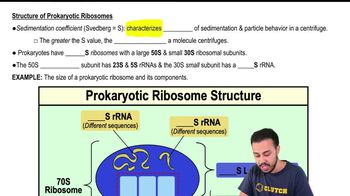
The Svedberg unit is a measure of sedimentation rate during centrifugation, reflecting how fast a particle sediments under centrifugal force. It is not a direct measure of size or mass but depends on shape and density, making it useful for comparing particles like ribosomal subunits.
Recommended video:
Guided course
05:05
Atoms- Smallest Unit of Matter

Sedimentation Rate and Centrifugation

Sedimentation rate refers to how quickly particles settle when spun at high speeds in a centrifuge. This rate depends on particle size, shape, and density, and is expressed in Svedberg units, which help differentiate cellular components such as ribosomes.
Recommended video:
Guided course
08:39
Structure of Prokaryotic Ribosomes

Notation and Abbreviation of Svedbergs

Svedberg units are abbreviated as 'S' (capital S) rather than 'sv.' This notation is standard in microbiology and biochemistry to denote sedimentation coefficients, especially when describing ribosomal subunits or other macromolecules.
Recommended video:
Guided course
08:39
Structure of Prokaryotic Ribosomes