 Back
BackInfection, Infectious Diseases, and Epidemiology: Core Concepts and Mechanisms
Study Guide - Smart Notes
 Tailored notes based on your materials, expanded with key definitions, examples, and context.
Infection, Infectious Diseases, and Epidemiology
Symbiotic Relationships Between Microbes and Their Hosts
Microorganisms interact with their hosts in various ways, forming symbiotic relationships that can impact health and disease. Symbiosis refers to the close association between two different species living together.
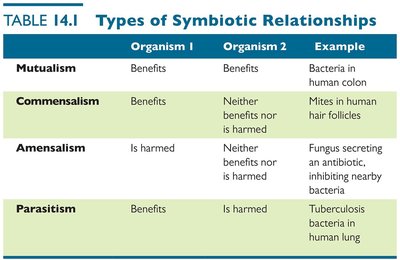
Mutualism: Both organisms benefit from the relationship. Example: Bacteria in the human colon synthesize vitamins and receive nutrients.
Commensalism: One organism benefits, while the other is neither helped nor harmed. Example: Mites in human hair follicles.
Amensalism: One organism is harmed, while the other is unaffected. Example: Fungi secreting antibiotics that inhibit nearby bacteria.
Parasitism: One organism benefits at the expense of the other. Example: Mycobacterium tuberculosis in human lungs.
Type | Organism 1 | Organism 2 | Example |
|---|---|---|---|
Mutualism | Benefits | Benefits | Bacteria in human colon |
Commensalism | Benefits | Neither benefits nor is harmed | Mites in human hair follicles |
Amensalism | Is harmed | Neither benefits nor is harmed | Fungus secreting an antibiotic, inhibiting nearby bacteria |
Parasitism | Benefits | Is harmed | Tuberculosis bacteria in human lung |
Microbiome of Humans
The human microbiome consists of all microorganisms that colonize the body's surfaces without causing disease under normal conditions. These are also called normal microbiota, normal flora, or indigenous microbiota.
Resident microbiota: Remain throughout life, mostly commensal.
Transient microbiota: Present for short periods; cannot persist due to competition, immune responses, or environmental changes.
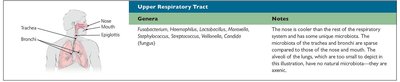
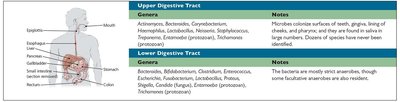
Major sites of normal microbiota include the skin, eyes, upper respiratory tract, and digestive tract.

Acquisition and Changes in the Microbiome
Humans are born without microbiota; colonization begins during birth and continues in the first months of life. The composition of the microbiome can change due to age, diet, environment, and health status.
Opportunistic Pathogens
Normal microbiota can become opportunistic pathogens under certain conditions, such as:
Introduction into unusual body sites
Immune suppression
Changes in the normal microbiota (e.g., antibiotic use)
Stressful conditions
Reservoirs of Infectious Diseases of Humans
Types of Reservoirs
Reservoirs are sites where pathogens are maintained as sources of infection. There are three main types:
Animal reservoirs: Pathogens that infect animals and can be transmitted to humans (zoonoses).
Human carriers: Infected individuals who may not show symptoms but can transmit pathogens.
Nonliving reservoirs: Soil, water, and food contaminated with infectious agents.
Zoonoses
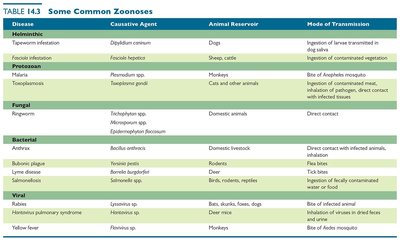
Zoonoses are diseases that naturally spread from animal hosts to humans. Transmission can occur through direct contact, consumption, or vectors such as arthropods. Humans are often dead-end hosts for these pathogens.
Disease | Causative Agent | Animal Reservoir | Mode of Transmission |
|---|---|---|---|
Tapeworm infestation | Dipylidium caninum | Dogs | Ingestion of larvae in dog saliva |
Malaria | Plasmodium spp. | Monkeys | Bite of Anopheles mosquito |
Rabies | Rabies virus | Bats, foxes, dogs | Bite of infected animal |
Anthrax | Bacillus anthracis | Domestic livestock | Direct contact with infected animal |
Yellow fever | Flavivirus spp. | Monkeys | Bite of Aedes mosquito |
The Invasion and Establishment of Microbes in Hosts: Infection
Contamination vs. Infection
Contamination is the mere presence of microbes on or in the body, while infection occurs when microbes evade external defenses, multiply, and establish themselves in the host.
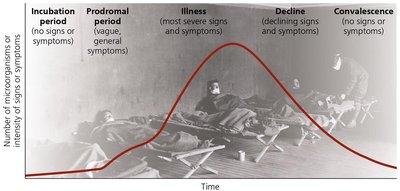
Stages of Infectious Diseases
Infectious diseases typically progress through several stages:
Incubation period: Time between infection and appearance of symptoms.
Prodromal period: Mild, general symptoms appear.
Illness: Most severe signs and symptoms.
Decline: Symptoms subside as immune response or treatment reduces pathogen numbers.
Convalescence: Recovery; no signs or symptoms remain.
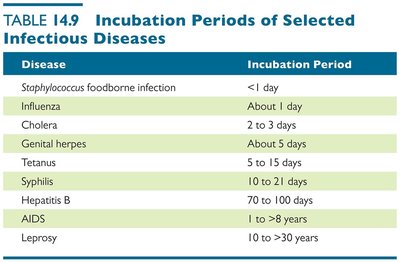
Incubation Periods of Selected Infectious Diseases
Disease | Incubation Period |
|---|---|
Staphylococcus foodborne infection | <1 day |
Influenza | About 1 day |
Cholera | 2 to 3 days |
Genital herpes | About 5 days |
Tetanus | 5 to 15 days |
Syphilis | 10 to 21 days |
Hepatitis B | 70 to 100 days |
AIDS | 1 to >8 years |
Leprosy | 10 to >30 years |
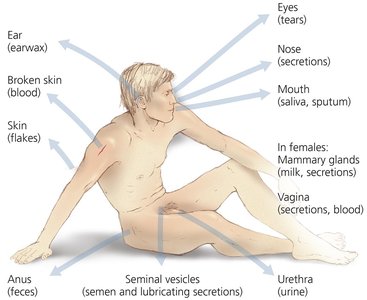
The Movement of Pathogens Out of Hosts: Portals of Exit
Portals of Exit
Pathogens leave the host through specific portals of exit, often the same as portals of entry. These include secretions, excretions, and other bodily fluids.
Modes of Infectious Disease Transmission
Overview of Transmission
Transmission is the movement of pathogens from a reservoir or portal of exit to another host's portal of entry. There are three main groups:
Contact transmission
Vehicle transmission
Vector transmission
Contact Transmission
Direct contact: Physical interaction between hosts (e.g., touching, kissing, sexual contact).
Indirect contact: Transmission via fomites (inanimate objects).
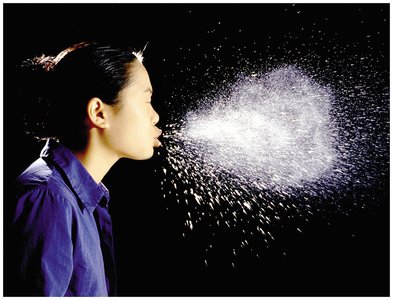
Droplet transmission: Spread via droplets of mucus from coughing, sneezing, or talking.
Vehicle Transmission
Airborne transmission: Pathogens travel more than 1 meter via aerosols (e.g., dust, droplets).
Waterborne transmission: Pathogens spread through contaminated water, often causing gastrointestinal diseases.
Foodborne transmission: Pathogens in or on foods, especially if improperly processed or stored.
Bodily fluid transmission: Pathogens in blood, urine, saliva, etc., can infect if they contact mucous membranes or broken skin.
Vector Transmission
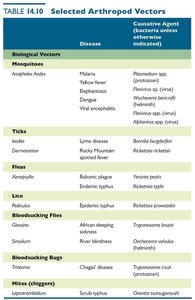
Biological vectors: Arthropods that transmit pathogens and serve as hosts for part of the pathogen's life cycle (e.g., mosquitoes, ticks).
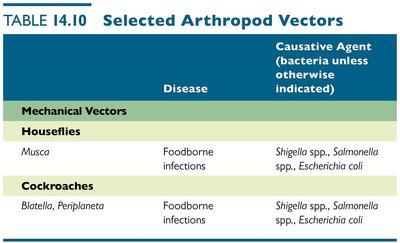
Mechanical vectors: Arthropods that passively carry pathogens on their bodies (e.g., houseflies, cockroaches).
Vector | Disease | Causative Agent |
|---|---|---|
Mosquitoes | Malaria, Yellow fever, Dengue | Plasmodium spp., Flavivirus spp. |
Ticks | Lyme disease, Rocky Mountain spotted fever | Borrelia burgdorferi, Rickettsia rickettsii |
Fleas | Bubonic plague | Yersinia pestis |
Houseflies | Foodborne infections | Shigella spp., Salmonella spp., Escherichia coli |
Cockroaches | Foodborne infections | Shigella spp., Salmonella spp., Escherichia coli |
Summary Table: Modes of Disease Transmission
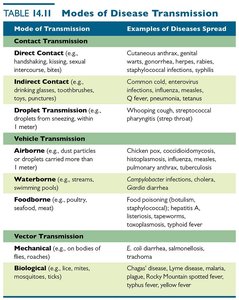
Mode of Transmission | Examples of Diseases Spread |
|---|---|
Direct Contact | Anthrax, herpes, syphilis |
Indirect Contact | Common cold, enterovirus infections |
Droplet Transmission | Whooping cough, strep throat |
Airborne | Chicken pox, tuberculosis |
Waterborne | Cholera, leptospirosis |
Foodborne | Food poisoning, hepatitis A |
Mechanical (vector) | E. coli diarrhea, salmonellosis |
Biological (vector) | Chagas' disease, malaria, typhus |
Additional info: Understanding these mechanisms is essential for controlling infectious diseases and preventing outbreaks in both clinical and public health settings.
