Ch. 19 - Pathogenic Gram-Positive Bacteria
Bauman - Microbiology with Diseases by Taxonomy 6th Edition
Bauman6th EditionMicrobiology with Diseases by TaxonomyISBN: 9780134832302Not the one you use?Change textbook
Chapter 19, Problem 6

Explain why Gram-positive mycoplasmas appear pink in a Gram-stained smear.

Verified step by step guidance
1
Recall that the Gram stain differentiates bacteria based on the structure of their cell walls: Gram-positive bacteria have a thick peptidoglycan layer that retains the crystal violet-iodine complex, appearing purple, while Gram-negative bacteria have a thinner peptidoglycan layer and do not retain the crystal violet, appearing pink after counterstaining with safranin.
Understand that mycoplasmas are unique bacteria that lack a cell wall entirely, meaning they do not have the peptidoglycan layer necessary to retain the crystal violet stain during the Gram staining process.
Since mycoplasmas lack the thick peptidoglycan layer, the crystal violet-iodine complex is washed away during the decolorization step of the Gram stain procedure.
After decolorization, mycoplasmas take up the counterstain safranin, which is pink/red, causing them to appear pink in the Gram-stained smear despite being classified as Gram-positive based on phylogeny.
Therefore, the pink appearance of Gram-positive mycoplasmas in a Gram stain is due to their lack of a cell wall, which prevents retention of the primary stain and results in uptake of the counterstain.

Verified video answer for a similar problem:

This video solution was recommended by our tutors as helpful for the problem above.
Video duration:
2m
Was this helpful?

Key Concepts

Here are the essential concepts you must grasp in order to answer the question correctly.

Gram Staining Mechanism

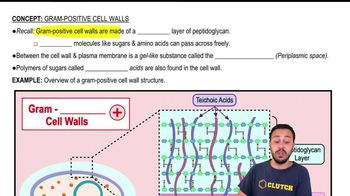
Gram staining differentiates bacteria based on cell wall structure. Gram-positive bacteria have thick peptidoglycan layers that retain the crystal violet-iodine complex, appearing purple, while Gram-negative bacteria have thinner walls and appear pink after counterstaining with safranin.
Recommended video:

Cell Wall Structure of Mycoplasmas

Mycoplasmas lack a cell wall entirely, including peptidoglycan, which is essential for retaining the crystal violet stain. This absence causes them to not retain the primary stain and instead take up the counterstain, appearing pink like Gram-negative bacteria.
Recommended video:
Guided course
02:59
Gram-Positive Cell Walls

Limitations of Gram Staining for Mycoplasmas

Because mycoplasmas lack a cell wall, Gram staining is unreliable for their identification. Their pink appearance in Gram stains is due to the uptake of the counterstain, not their Gram reaction, highlighting the need for alternative diagnostic methods.
Recommended video: