Ch. 19 - Pathogenic Gram-Positive Bacteria
Bauman - Microbiology with Diseases by Taxonomy 6th Edition
Bauman6th EditionMicrobiology with Diseases by TaxonomyISBN: 9780134832302Not the one you use?Change textbook
Chapter 19, Problem 1

Match the genera of pathogens to their appearance in stained smears: Actinomyces, Bacillus, Clostridium, Mycobacterium, Staphylococcus, Streptococcus.
(a) Methenamine silver <IMAGE>
(b) Gram <IMAGE>
(c) Gram <IMAGE>
(d) Acid fast <IMAGE>
(e) Gram <IMAGE>
(f) Gram <IMAGE>

Verified step by step guidance
1
Step 1: Understand the staining techniques mentioned and their typical applications. Methenamine silver stain is often used to detect fungi and some bacteria with unique cell wall components. Gram stain differentiates bacteria into Gram-positive (purple) and Gram-negative (pink/red) based on cell wall structure. Acid-fast stain is used primarily for Mycobacterium species due to their waxy, mycolic acid-rich cell walls.
Step 2: Recall the general characteristics of each genus: Actinomyces are Gram-positive branching filamentous bacteria; Bacillus are large Gram-positive rods, often forming spores; Clostridium are Gram-positive rods, anaerobic and spore-forming; Mycobacterium are acid-fast rods; Staphylococcus are Gram-positive cocci in clusters; Streptococcus are Gram-positive cocci in chains.
Step 3: Match the genera to the staining method and expected morphology: (a) Methenamine silver stain likely highlights Actinomyces due to their filamentous nature; (b), (c), (e), and (f) are Gram stains showing different morphologies—identify which images show rods or cocci and their arrangements to assign Bacillus, Clostridium, Staphylococcus, and Streptococcus accordingly; (d) Acid-fast stain corresponds to Mycobacterium.
Step 4: Use the morphology clues from the images (if available) to distinguish between rods and cocci, and their arrangements (chains vs clusters), which helps differentiate Bacillus, Clostridium, Staphylococcus, and Streptococcus in Gram stains.
Step 5: Finalize the matching by pairing each genus with the staining method and morphology that best fits their known characteristics, ensuring Mycobacterium is matched with acid-fast stain and Actinomyces with methenamine silver stain.

Verified video answer for a similar problem:

This video solution was recommended by our tutors as helpful for the problem above.
Video duration:
2m
Was this helpful?

Key Concepts

Here are the essential concepts you must grasp in order to answer the question correctly.

Bacterial Staining Techniques

Staining methods like Gram stain, acid-fast stain, and methenamine silver stain are used to visualize bacteria under a microscope. Each technique highlights different bacterial features based on cell wall properties, aiding in identification. For example, Gram stain differentiates bacteria into Gram-positive or Gram-negative, while acid-fast stain detects mycobacteria with waxy cell walls.
Recommended video:
Guided course
02:10
Introduction to Staining

Morphology and Characteristics of Bacterial Genera

Different bacterial genera have distinct shapes and staining properties. Bacillus and Clostridium are Gram-positive rods, Actinomyces are filamentous Gram-positive bacteria, Staphylococcus and Streptococcus are Gram-positive cocci with different arrangements, and Mycobacterium is acid-fast due to mycolic acid in its cell wall. Recognizing these traits helps match bacteria to their stained appearances.
Recommended video:
Guided course
02:44
Types of Bacterial Cell Morphology

Correlation Between Staining Results and Bacterial Identification

Interpreting stained smears requires linking staining patterns to bacterial identity. For instance, acid-fast positive staining indicates Mycobacterium, while methenamine silver stain is used for certain fungi and bacteria with specific cell wall components. Understanding these correlations enables accurate matching of genera to their microscopic images.
Recommended video:
Guided course
05:30
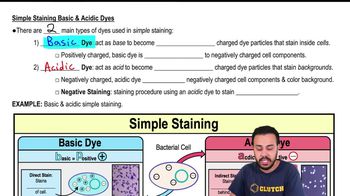
Simple Staining Basic & Acidic Dyes
Related Practice
Textbook Question

Mycobacterium avium-intracellulare was considered relatively harmless until the late 20th century, when it became common in certain infections. Explain how this bacterium’s pathogenicity changed.

1136
views

Textbook Question

Why are mycoplasmas able to survive a relatively wide range of osmotic conditions, even though these bacteria lack cell walls?

1205
views
Textbook Question

How does Staphylococcus aureus affect the matrix between cells in the human body?

a. S. aureus triggers blood clotting, which coats the matrix and inhibits cellular

communication.

b. S. aureus produces an enzyme that dissolves hyaluronic acid and thus enables it to pass between the cells.

c. S. aureus possesses a hyaluronic acid capsule that causes leukocytes to ignore the bacterium as if it were camouflaged.

d. S. aureus does not affect the matrix but instead produces a necrotizing agent that dissolves body cells.

42
views
Textbook Question

Which of the following bacteria causes a common type of food poisoning?

a. Streptococcus sanguis

b. Clostridium tetani

c. Staphylococcus aureus

d. Streptococcus pyogenes

34
views
Textbook Question

For each of the following diseases or conditions, indicate the genus (or genera) of bacterium that causes it.


___ Scalded skin syndrome

___ Osteomyelitis

___ Pharyngitis

___ Scarlet fever

___ Pyoderma

___ Rheumatic fever

___ Glomerulonephritis

___ Sinusitis

___ Otitis media

___ Anthrax

___ Myonecrosis

___ Diphtheria

___ Leprosy

___ Dental caries

___ Acne


A. Staphylococcus

B. Streptococcus

C. Mycobacterium

D. Listeria

E. Propionibacterium

F. Corynebacterium

G. Bacillus

H. Clostridium

I. Actinomyces

967
views