Ch. 3 - Cell Structure and Function
Bauman - Microbiology with Diseases by Taxonomy 6th Edition
Bauman6th EditionMicrobiology with Diseases by TaxonomyISBN: 9780134832302Not the one you use?Change textbook
Chapter 3, Problem 5

A local newspaper writer has contacted you, an educated microbiology student from a respected college. He wants to obtain scientific information for an article he is writing about “life” and poses the following query: “What is the difference between a living thing and a nonliving thing?” Knowing that he will edit your material to fit the article, give an intelligent, scientific response.

Verified step by step guidance
1
Begin by defining what constitutes a living thing in scientific terms: living organisms exhibit characteristics such as metabolism, growth, reproduction, response to stimuli, and homeostasis.
Explain that living things are composed of cells, which are the basic units of life, and they carry genetic information in the form of DNA or RNA.
Contrast this with nonliving things, which do not show these characteristics; they do not grow, reproduce, metabolize, or respond to their environment.
Highlight that nonliving things can be made of matter and may undergo physical or chemical changes, but these changes are not driven by biological processes.
Summarize by stating that the key difference lies in the presence of biological processes and cellular organization in living things, which nonliving things lack.

Verified video answer for a similar problem:

This video solution was recommended by our tutors as helpful for the problem above.
Video duration:
2m
Was this helpful?

Key Concepts

Here are the essential concepts you must grasp in order to answer the question correctly.

Characteristics of Living Things

Living things exhibit key features such as growth, reproduction, metabolism, response to stimuli, and cellular organization. These characteristics distinguish them from nonliving things, which do not perform biological processes or maintain homeostasis.
Recommended video:
Guided course
05:09
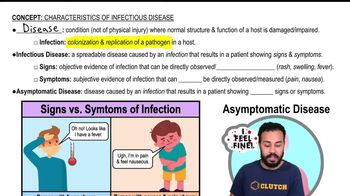
Intro to Characteristics of Infectious Disease

Cellular Organization

All living organisms are composed of one or more cells, which are the basic units of life. Cells carry out essential functions like energy production and genetic information storage, whereas nonliving things lack cellular structure.
Recommended video:
Guided course
05:22
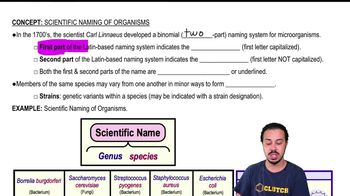
Scientific Naming of Organisms

Metabolism and Energy Use

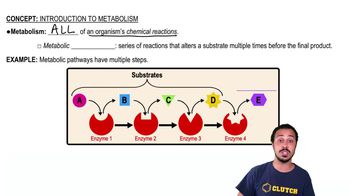
Living organisms undergo metabolism, a set of chemical reactions that convert energy to sustain life processes. Nonliving things do not metabolize or use energy to maintain internal order or grow.
Recommended video:
Guided course
02:17
Introduction to Metabolism