
Textbook Question
How would each of the following prevent infection?
a. Antibodies against Neisseria gonorrhoeae fimbriae
b. Antibodies against host cell mannose
1537
views

 Verified step by step guidance
 06:59
06:59
 07:22
07:22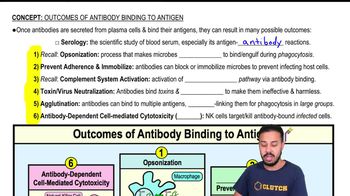 09:16
09:16How would each of the following prevent infection?
a. Antibodies against Neisseria gonorrhoeae fimbriae
b. Antibodies against host cell mannose
Match the following choices to the statements in questions 5–7:
a. IgA
b. IgD
c. IgE
d. IgG
e. IgM
The first antibodies synthesized; especially effective against microorganisms.
Match the following choices to the statements in questions 5–7:
a. IgA
b. IgD
c. IgE
d. IgG
e. IgM
Antibodies that protect the fetus and newborn.
Match the following choices to the statements in questions 5–7:
a. IgA
b. IgD
c. IgE
d. IgG
e. IgM
Antibodies that are bound to mast cells and involved in allergic reactions.
Match the following choices to questions 1–4:
a. Innate resistance
b. Naturally acquired active immunity
c. Naturally acquired passive immunity
d. Artificially acquired active immunity
e. Artificially acquired passive immunity
A newborn’s immunity to yellow fever.
Explain a function for the following types of cells: CTL, TH, and Treg. What is a cytokine?