



Ch. 21 - Microbial Diseases of the Skin and Eyes
Tortora - Microbiology: An Introduction 14th Edition
Tortora14th EditionMicrobiology: An IntroductionISBN: 9780138200398Not the one you use?Change textbook
Chapter 21, Problem 4

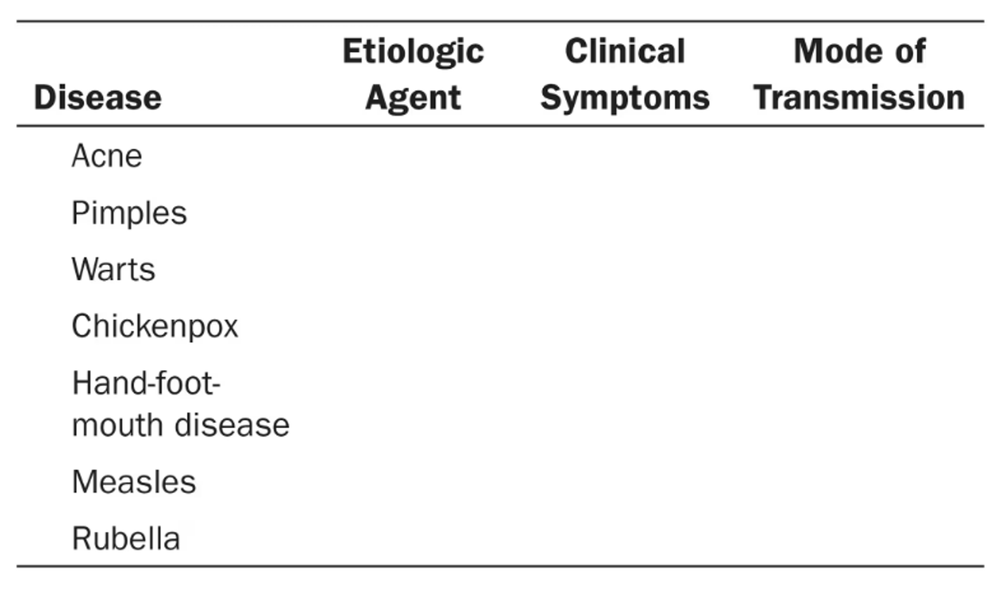
Complete the following table of epidemiology.
Table with columns for disease, etiologic agent, clinical symptoms, and transmission mode, listing seven diseases.

Verified step by step guidance
1
Identify the key epidemiological measures that the table requires, such as incidence, prevalence, attack rate, mortality rate, or case fatality rate. Understanding what each measure represents is crucial before filling in the table.
Gather the necessary data from the problem or image, such as the number of new cases, total population at risk, number of existing cases, number of deaths, and time period involved. These values are essential inputs for the calculations.
Use the appropriate formulas for each epidemiological measure. For example, incidence rate is calculated as \(\text{Incidence Rate} = \frac{\text{Number of new cases during a time period}}{\text{Population at risk during the same time period}} \times 10^n\), where \$10^n$ is a multiplier like 1000 or 100,000 depending on the context.
Calculate prevalence using the formula \(\text{Prevalence} = \frac{\text{Total number of cases (new and existing) at a given time}}{\text{Total population at the same time}} \times 10^n\). This gives a snapshot of disease burden.
For mortality or case fatality rates, apply the formulas: \(\text{Mortality Rate} = \frac{\text{Number of deaths due to disease}}{\text{Total population}} \times 10^n\) and \(\text{Case Fatality Rate} = \frac{\text{Number of deaths due to disease}}{\text{Number of diagnosed cases}} \times 100\%\). Fill in the table accordingly after performing these calculations.

Verified video answer for a similar problem:

This video solution was recommended by our tutors as helpful for the problem above.
Video duration:
2m
Was this helpful?

Key Concepts

Here are the essential concepts you must grasp in order to answer the question correctly.

Epidemiological Measures

Epidemiological measures such as incidence, prevalence, morbidity, and mortality rates quantify the frequency and impact of diseases within populations. Understanding these metrics is essential for interpreting data in epidemiology tables and assessing public health trends.
Recommended video:
Guided course
03:27
Measuring Total Weight

Disease Transmission and Patterns

Knowledge of how diseases spread (e.g., direct contact, vectors, airborne) and their patterns (endemic, epidemic, pandemic) helps in analyzing epidemiological data. This concept aids in understanding the context behind the numbers and the dynamics of disease outbreaks.
Recommended video:
Guided course
04:24
Pattern Recognition Receptors

Data Interpretation in Epidemiology

Interpreting epidemiological tables requires skills in analyzing statistical data, recognizing relationships between variables, and drawing conclusions about disease distribution and risk factors. This concept is crucial for completing and understanding epidemiology tables accurately.
Recommended video:
Guided course
06:29
Scientific Method
Related Practice
Textbook Question

A patient has conjunctivitis. If you isolated Pseudomonas from the patient’s mascara, you would most likely conclude all of the following except that

a. The mascara was the source of the infection.

b. Pseudomonas is causing the infection.

c. Pseudomonas has been growing in the mascara.

d. The mascara was contaminated by the manufacturer.

e. All of the above are valid conclusions.

1192
views
Textbook Question

A 12-year old boy had a fever, rash, headache, sore throat, and cough. He also had a macular rash on his trunk, face, and arms. A throat culture was negative for Streptococcus pyogenes.

The boy most likely had

a. Streptococcal sore throat.

b. Measles.

c. Rubella.

d. Smallpox.

e. Hand-foot-mouth disease.

1230
views
Textbook Question

Before 2005, why was a test for antibodies against rubella required for females under age 50 before issuing a marriage license?

1240
views
Textbook Question

On the following figure, show the sites of the following infections: impetigo, folliculitis, acne, warts, shingles, sporotrichosis, pediculosis.

<IMAGE>

1217
views
Textbook Question

What bacteria are identified by a positive coagulase test? What bacteria are characterized as group A beta-hemolytic?

1583
views
Textbook Question

A 12-year old boy had a fever, rash, headache, sore throat, and cough. He also had a macular rash on his trunk, face, and arms. A throat culture was negative for Streptococcus pyogenes.

All of the following are complications of this disease except

a. Middle ear infections.

b. Pneumonia.

c. Birth defects.

d. Encephalitis.

e. All are complications of this disease.

842
views