


Ch. 21 - Microbial Diseases of the Skin and Eyes
Tortora - Microbiology: An Introduction 14th Edition
Tortora14th EditionMicrobiology: An IntroductionISBN: 9780138200398Not the one you use?Change textbook
Chapter 21, Problem 3

On the following figure, show the sites of the following infections: impetigo, folliculitis, acne, warts, shingles, sporotrichosis, pediculosis.
<IMAGE>

Verified step by step guidance
1
Step 1: Understand the nature and typical location of each infection or condition on the human body. For example, impetigo is a superficial bacterial skin infection usually found on the face and limbs.
Step 2: Identify folliculitis as an infection of the hair follicles, which can occur anywhere hair grows but is commonly seen on the scalp, beard area, or limbs.
Step 3: Recognize acne as a condition affecting the sebaceous glands, primarily on the face, chest, and back.
Step 4: Know that warts are caused by human papillomavirus (HPV) and typically appear on hands, fingers, and sometimes feet.
Step 5: Locate shingles (herpes zoster) along specific dermatomes, often appearing as a painful rash on one side of the torso or face; sporotrichosis is a fungal infection usually affecting the skin on the arms or hands after trauma; pediculosis refers to lice infestation, commonly found on the scalp (head lice), body, or pubic area.

Verified video answer for a similar problem:

This video solution was recommended by our tutors as helpful for the problem above.
Video duration:
2m
Was this helpful?

Key Concepts

Here are the essential concepts you must grasp in order to answer the question correctly.

Skin Structure and Layers

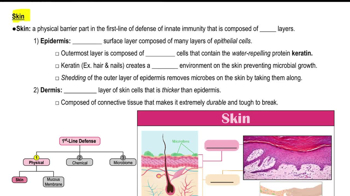
Understanding the anatomy of the skin, including the epidermis, dermis, and hair follicles, is essential to locate where infections like impetigo, folliculitis, and acne occur. Different infections target specific layers or structures, influencing their clinical presentation and treatment.
Recommended video:
Guided course
01:53
Capsules vs. Slime Layers

Types of Skin Infections and Their Etiology

Each infection listed—impetigo, folliculitis, acne, warts, shingles, sporotrichosis, and pediculosis—has a distinct cause, such as bacteria, viruses, fungi, or parasites. Recognizing the pathogen type helps in identifying the infection site and understanding its pathogenesis.
Recommended video:
Guided course
01:28
Physical Barriers in First-Line Defenses: Skin

Pathophysiology and Clinical Manifestations of Skin Infections

Knowing how each infection develops and presents clinically aids in mapping them onto the skin diagram. For example, shingles follows nerve dermatomes, warts affect epidermal layers, and pediculosis involves hair shafts, which guides accurate localization on the figure.
Recommended video:
Guided course
03:58
Physical Barriers in First-Line Defenses: Skin
Related Practice
Textbook Question

A 12-year old boy had a fever, rash, headache, sore throat, and cough. He also had a macular rash on his trunk, face, and arms. A throat culture was negative for Streptococcus pyogenes.

The boy most likely had

a. Streptococcal sore throat.

b. Measles.

c. Rubella.

d. Smallpox.

e. Hand-foot-mouth disease.

1230
views
Textbook Question

A 6-year old girl was taken to the physician for evaluation of a slowly growing bump on the back of her head. The bump was a raised, scaling lesion 4 cm in diameter. A fungal culture of material from the lesion was positive for a fungus with numerous conidia.

The girl’s disease was

a. Rubella.

b. Candidiasis.

c. Dermatomycosis.

d. A cold sore.

e. None of the above.

856
views
Textbook Question

What bacteria are identified by a positive coagulase test? What bacteria are characterized as group A beta-hemolytic?

1583
views
Textbook Question

A 6-year old girl was taken to the physician for evaluation of a slowly growing bump on the back of her head. The bump was a raised, scaling lesion 4 cm in diameter. A fungal culture of material from the lesion was positive for a fungus with numerous conidia.

Besides the scalp, this disease can occur on all of the following except

a. Feet.

b. Nails.

c. The groin.

d. Subcutaneous tissue.

e. The disease can occur on all of these areas.

1219
views
Textbook Question

Complete the following table of epidemiology.

1301
views
Textbook Question

A 12-year old boy had a fever, rash, headache, sore throat, and cough. He also had a macular rash on his trunk, face, and arms. A throat culture was negative for Streptococcus pyogenes.

All of the following are complications of this disease except

a. Middle ear infections.

b. Pneumonia.

c. Birth defects.

d. Encephalitis.

e. All are complications of this disease.

842
views