 Back
BackThe Nervous System: Structure, Function, and Disorders
Study Guide - Smart Notes
 Tailored notes based on your materials, expanded with key definitions, examples, and context.
The Nervous System: Overview
Main Divisions and Functions
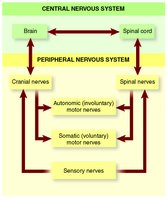
The nervous system is a complex network responsible for coordinating the body's activities by transmitting signals to and from different parts. It is divided into the central nervous system (CNS) and the peripheral nervous system (PNS). The CNS consists of the brain and spinal cord, while the PNS includes all other neural elements such as cranial and spinal nerves. The nervous system's primary functions are sensory input, integration, and motor output.
Central Nervous System (CNS): Integrates and processes information; includes the brain and spinal cord.
Peripheral Nervous System (PNS): Transmits signals between the CNS and the rest of the body; includes cranial and spinal nerves.
Autonomic Nervous System (ANS): Subdivision of the PNS; controls involuntary functions (e.g., heart rate, digestion).
Somatic Nervous System: Subdivision of the PNS; controls voluntary movements.
Cells of the Nervous System
Neurons: Structure and Function
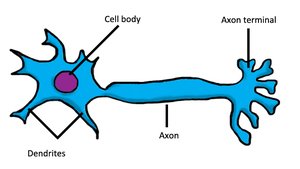
Neurons are the primary signaling cells of the nervous system. Each neuron consists of three main parts: the cell body, dendrites, and axon. Dendrites receive incoming signals, while the axon transmits impulses away from the cell body to other neurons or effectors.
Cell Body (Soma): Contains the nucleus and organelles; metabolic center of the neuron.
Dendrites: Branch-like extensions that receive signals from other neurons.
Axon: Long projection that carries impulses away from the cell body.
Types of Neurons
Sensory (Afferent) Neurons: Transmit impulses from sensory receptors to the CNS.
Motor (Efferent) Neurons: Carry impulses from the CNS to muscles and glands.
Interneurons: Connect sensory and motor neurons within the CNS.
Glial Cells (Neuroglia)
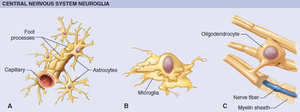
Glia are support cells in the nervous system that do not conduct impulses but provide structural and functional support to neurons. Major types include:
Astrocytes: Anchor blood vessels to neurons and form the blood-brain barrier.
Microglia: Act as phagocytes, cleaning up debris and pathogens in the CNS.
Oligodendrocytes: Form myelin sheaths around axons in the CNS.
Schwann Cells: Form myelin sheaths in the PNS (not shown in image below).
Structure of a Nerve
Nerve Organization and Coverings
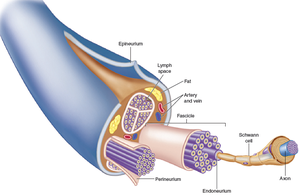
A nerve is a bundle of peripheral axons, often covered by myelin sheaths. Nerves are organized into fascicles, each surrounded by connective tissue layers:
Endoneurium: Surrounds individual nerve fibers.
Perineurium: Surrounds groups of fibers (fascicles).
Epineurium: Encloses the entire nerve.
Reflex Arcs
Simple and Complex Reflexes
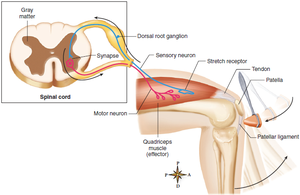
Reflex arcs are the basic functional units of the nervous system, allowing for rapid, automatic responses to stimuli. The simplest reflex arc involves two neurons (sensory and motor), while more complex arcs include interneurons.
Two-Neuron Arc: Sensory neuron synapses directly with a motor neuron.
Three-Neuron Arc: Sensory neuron synapses with an interneuron, which then synapses with a motor neuron.
Effector: The muscle or gland that responds to the motor neuron signal.
Nerve Impulses
Mechanism of Transmission
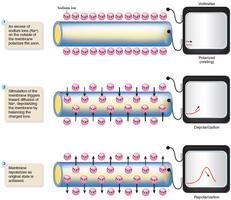
A nerve impulse (action potential) is a self-propagating wave of electrical disturbance that travels along the neuron membrane. The process involves three main steps:
Polarization: Resting state; inside of the neuron is negatively charged relative to the outside due to Na+ distribution.
Depolarization: Stimulus opens Na+ channels, allowing Na+ to enter and making the inside more positive.
Repolarization: Restoration of the resting state as K+ exits the cell and Na+ channels close.
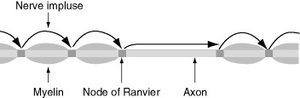
Saltatory conduction occurs in myelinated axons, where the impulse jumps from one node of Ranvier to the next, increasing conduction speed.
Synapses and Neurotransmitters
Structure and Function of Synapses
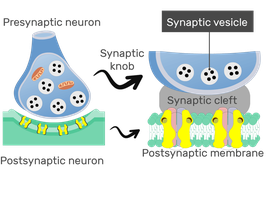
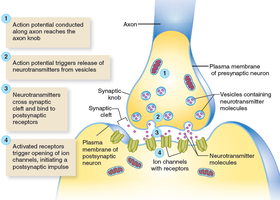
A synapse is the junction where a neuron communicates with another cell. It consists of the synaptic knob, synaptic cleft, and postsynaptic membrane. Neurotransmitters are released from vesicles in the synaptic knob, cross the synaptic cleft, and bind to receptors on the postsynaptic membrane, triggering a response.
Synaptic Knob: Contains neurotransmitter vesicles.
Synaptic Cleft: Small gap between neurons.
Postsynaptic Membrane: Contains receptors for neurotransmitters.
Major Neurotransmitters
Acetylcholine: Involved in muscle contraction and autonomic functions.
Catecholamines: Includes norepinephrine, dopamine, and serotonin; involved in mood, alertness, and motor control.
Endorphins and Enkephalins: Natural painkillers.
Nitric Oxide (NO): Involved in memory and vasodilation.
Parkinson disease is associated with low dopamine levels in motor control areas, leading to tremors and rigidity.
Conditions of Nervous Tissue
Multiple Sclerosis (MS)
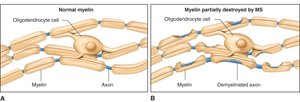
Multiple sclerosis is an autoimmune disorder characterized by the loss of myelin in central nerve fibers, leading to impaired nerve conduction. Symptoms include weakness, loss of coordination, and visual or speech impairment. Myelin destruction is replaced by hard plaques.
Neuromas and Neurofibromatosis
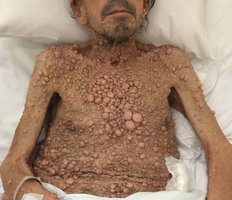
Neuromas are tumors of nervous tissue, most commonly gliomas (arising from glial cells). Multiple neurofibromatosis is an inherited disorder with numerous benign tumors on Schwann cells, often visible as nodules on the skin.
Additional info: The nervous system is essential for integrating sensory information, coordinating voluntary and involuntary actions, and maintaining homeostasis. Disorders of the nervous system can have profound effects on overall health and quality of life.
