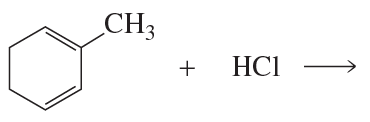
What are the major 1,2- and 1,4-addition products of the following reaction? Indicate the kinetic and the thermodynamic products. a.
Verified step by step guidance
1
Analyze the given structure: The molecule is a conjugated diene, specifically 2-methyl-1,3-cyclopentadiene. Conjugated dienes are capable of undergoing 1,2- and 1,4-addition reactions when reacted with electrophiles.
Understand the reaction mechanism: In the presence of an electrophile (e.g., HBr), the double bonds in the conjugated diene can react to form carbocation intermediates. The electrophile will add to one of the double bonds, creating a carbocation at the adjacent carbon.
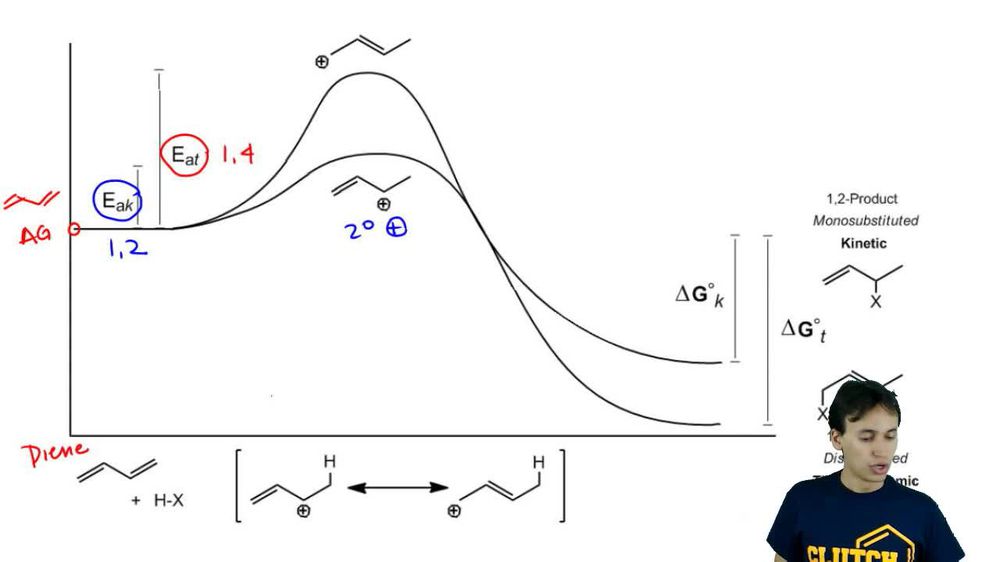
Determine the 1,2-addition product: The electrophile adds to the first double bond, and the nucleophile (e.g., Br⁻) attaches to the carbocation formed on the adjacent carbon. This product is typically the kinetic product because it forms faster due to proximity of the nucleophile to the carbocation.
Determine the 1,4-addition product: The electrophile adds to the first double bond, but the carbocation rearranges to the fourth carbon in the conjugated system. The nucleophile then attaches to this rearranged carbocation. This product is typically the thermodynamic product because it is more stable due to conjugation.
Compare kinetic and thermodynamic products: The kinetic product (1,2-addition) forms faster at lower temperatures, while the thermodynamic product (1,4-addition) is favored at higher temperatures due to its greater stability. Analyze the reaction conditions to predict which product will dominate.
Verified video answer for a similar problem:
This video solution was recommended by our tutors as helpful for the problem above
Video duration:
7m
Play a video:
0 Comments
Key Concepts
Here are the essential concepts you must grasp in order to answer the question correctly.
1,2- and 1,4-Addition Reactions
1,2- and 1,4-addition reactions refer to the ways in which reagents can add to conjugated systems, such as alkenes. In 1,2-addition, the reagent adds to the first and second carbon atoms of the double bond, while in 1,4-addition, it adds to the first and fourth carbon atoms. These pathways lead to different products, which can have distinct stability and reactivity.
Kinetic and thermodynamic products arise from different reaction conditions and pathways. Kinetic products are formed faster and are typically less stable, while thermodynamic products are more stable and form more slowly. Understanding the conditions that favor one over the other, such as temperature and reaction time, is crucial for predicting the outcome of addition reactions.
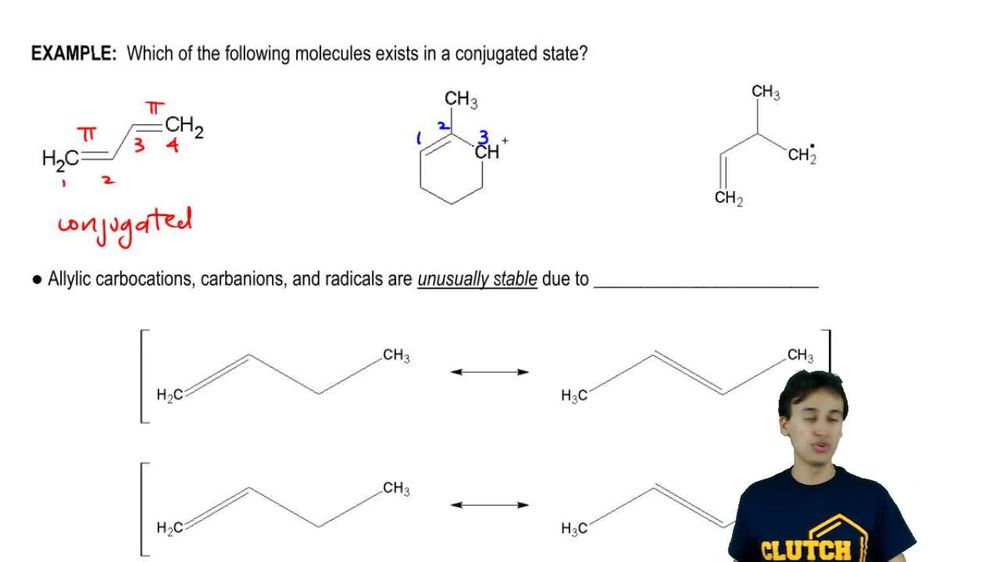
Conjugated systems are compounds with alternating single and double bonds, which allow for delocalization of electrons. This delocalization stabilizes the molecule and influences its reactivity. In the context of addition reactions, the presence of conjugation can affect the regioselectivity and the stability of the products formed, making it essential to consider when analyzing reaction outcomes.