The experiment shown next and discussed in Section 8.13 shows that the proximity of the chloride ion to C-2 in the transition state causes the 1,2-addition product to form more rapidly than the 1,4-addition product. a. Why was it important for the investigators to know that the preceding reaction was being carried out under kinetic control?
Verified step by step guidance
1
Understand the concept of kinetic control: A reaction is said to be under kinetic control when the product distribution is determined by the relative rates of formation of the products, rather than their thermodynamic stability. This means the product that forms faster will dominate, even if it is less stable.
Recognize the importance of kinetic control in this experiment: The investigators needed to confirm that the reaction was under kinetic control to ensure that the observed product distribution (1,2-addition vs. 1,4-addition) was due to the relative rates of formation of these products, not their thermodynamic stability.
Relate kinetic control to the transition state: Under kinetic control, the proximity of the chloride ion to C-2 in the transition state would favor the formation of the 1,2-addition product because it can form more rapidly due to the closer interaction between the chloride ion and the carbocation intermediate.
Consider the implications of thermodynamic control: If the reaction were under thermodynamic control, the product distribution would depend on the relative stabilities of the 1,2-addition and 1,4-addition products. This would make it difficult to study the effect of the chloride ion's proximity on the reaction rate.
Conclude why kinetic control is critical: By confirming kinetic control, the investigators could directly correlate the proximity of the chloride ion to the observed faster formation of the 1,2-addition product, providing insight into the reaction mechanism.
Verified video answer for a similar problem:
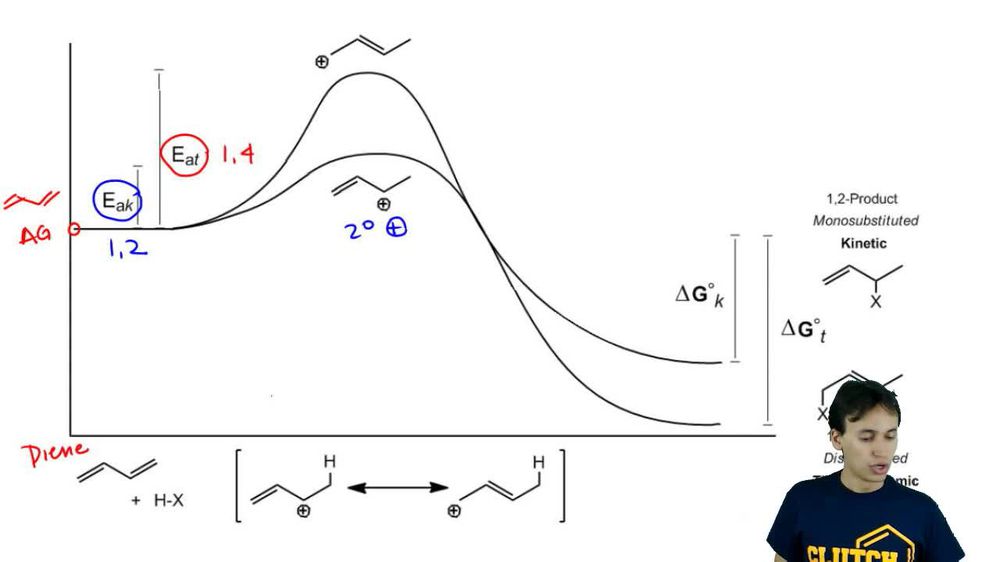
This video solution was recommended by our tutors as helpful for the problem above
Video duration:
4m
Play a video:
0 Comments
Key Concepts
Here are the essential concepts you must grasp in order to answer the question correctly.
Kinetic Control
Kinetic control refers to a reaction condition where the product distribution is determined by the rate at which products form, rather than their stability. Under kinetic control, the pathway leading to the fastest-forming product is favored, which is crucial in understanding why the 1,2-addition product forms more rapidly than the 1,4-addition product in this scenario.
The transition state is a high-energy, unstable arrangement of atoms that occurs during a chemical reaction. It represents the point at which reactants are transformed into products. In this case, the proximity of the chloride ion to C-2 in the transition state influences the rate of formation of the 1,2-addition product, highlighting the importance of molecular interactions in determining reaction pathways.
Product selectivity refers to the preference for one product over another in a chemical reaction. In the context of this question, understanding product selectivity is essential because it explains why the 1,2-addition product is favored under kinetic control, as the reaction conditions and transition state favor the formation of this product over the more stable but slower-forming 1,4-addition product.