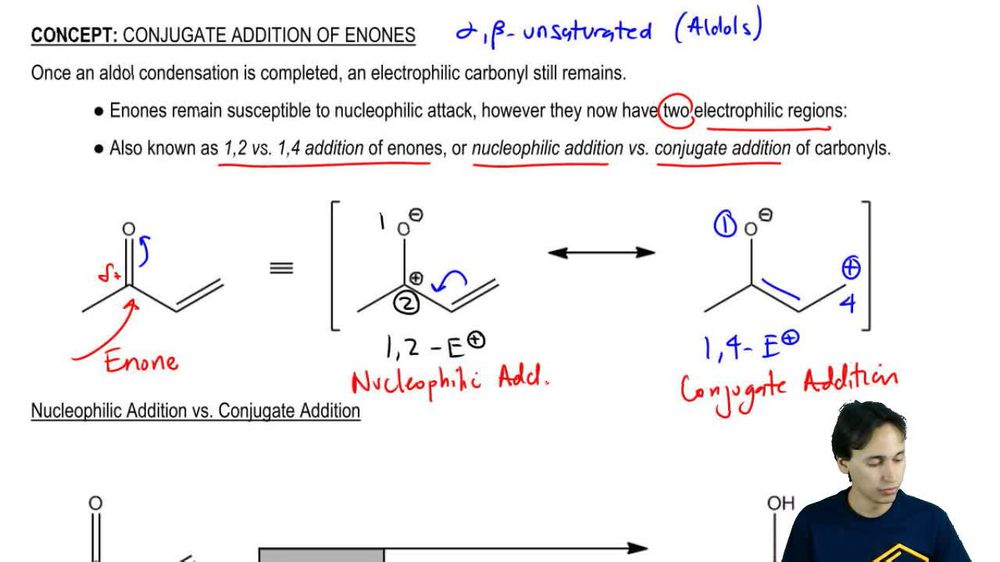
A student wanted to know whether the greater proximity of the nucleophile to the C-2 carbon in the transition state is what causes the 1,2-addition product to be formed faster when 1,3-butadiene reacts with HCl. Therefore, she decided to investigate the reaction of 2-methyl-1,3-cyclohexadiene with HCl. Her friend told her that she should use 1-methyl-1,3-cyclohexadiene instead. Should she follow her friend's advice?
Verified step by step guidance
1
Step 1: Understand the context of the problem. The question revolves around the regioselectivity of the reaction of conjugated dienes with HCl, specifically the formation of 1,2-addition and 1,4-addition products. The student is investigating whether the proximity of the nucleophile (Cl⁻) to the C-2 carbon in the transition state influences the reaction outcome.
Step 2: Analyze the structure of 2-methyl-1,3-cyclohexadiene. This compound has a methyl group at the C-2 position, which could sterically hinder the approach of the nucleophile to the C-2 carbon. This steric hindrance might affect the formation of the 1,2-addition product.
Step 3: Compare this to 1-methyl-1,3-cyclohexadiene. In this compound, the methyl group is at the C-1 position, which does not directly interfere with the approach of the nucleophile to the C-2 carbon. This makes it a better model for studying the effect of nucleophile proximity to the C-2 carbon in the transition state.
Step 4: Consider the goal of the experiment. The student wants to isolate the effect of nucleophile proximity to the C-2 carbon. Using 2-methyl-1,3-cyclohexadiene introduces steric effects that could confound the results. On the other hand, 1-methyl-1,3-cyclohexadiene minimizes these steric effects, making it a more suitable choice for the investigation.
Step 5: Conclude that the friend’s advice is correct. The student should use 1-methyl-1,3-cyclohexadiene instead of 2-methyl-1,3-cyclohexadiene to better study the effect of nucleophile proximity to the C-2 carbon in the transition state without introducing additional steric hindrance.
Verified video answer for a similar problem:
This video solution was recommended by our tutors as helpful for the problem above
Video duration:
13m
Play a video:
0 Comments
Key Concepts
Here are the essential concepts you must grasp in order to answer the question correctly.
Nucleophilicity and Electrophilicity
Nucleophilicity refers to the ability of a nucleophile to donate an electron pair to an electrophile, which is an electron-deficient species. In the context of the reaction between 1,3-butadiene and HCl, the nucleophile (the double bond in butadiene) interacts with the electrophile (HCl), leading to the formation of addition products. Understanding the relative strengths of nucleophiles and electrophiles is crucial for predicting reaction pathways and product formation.
Transition state theory posits that during a chemical reaction, reactants pass through a high-energy transition state before forming products. The stability and structure of this transition state can significantly influence the reaction rate. In the case of 1,2-addition versus 1,4-addition in conjugated systems like 1,3-butadiene, the proximity of the nucleophile to the electrophilic center in the transition state can determine which product is formed more rapidly.
Regioselectivity refers to the preference of a chemical reaction to yield one structural isomer over others when multiple products are possible. In the reaction of 1,3-butadiene with HCl, the formation of 1,2-addition products versus 1,4-addition products illustrates this concept. The choice of substrate, such as 2-methyl-1,3-cyclohexadiene versus 1-methyl-1,3-cyclohexadiene, can influence the regioselectivity and thus the reaction outcome, making it essential to consider the structural implications of the chosen reactants.