Ionic compounds like sodium acetate have a high melting point. Despite this, they are highly soluble in water. Why?
Verified step by step guidance
1
Ionic compounds like sodium acetate and sodium carbonate consist of positively charged cations (e.g., Na⁺) and negatively charged anions (e.g., acetate or carbonate). These ions are held together by strong electrostatic forces, known as ionic bonds, which contribute to their high melting points.
Despite their high melting points, ionic compounds are highly soluble in water due to the polar nature of water molecules. Water molecules have a partial positive charge on the hydrogen atoms and a partial negative charge on the oxygen atom, allowing them to interact with and stabilize the ions in the ionic compound.
When an ionic compound dissolves in water, the water molecules surround the individual ions in a process called hydration. The oxygen atom in water interacts with the cation (e.g., Na⁺), while the hydrogen atoms interact with the anion (e.g., acetate or carbonate). This reduces the electrostatic attraction between the ions and allows them to disperse in solution.
The solubility of ionic compounds in water is also influenced by the lattice energy of the compound, which is the energy required to separate the ions in the solid lattice. If the hydration energy (energy released when ions are surrounded by water molecules) is greater than the lattice energy, the compound will dissolve readily in water.
In the case of sodium acetate or sodium carbonate, the hydration energy provided by water molecules is sufficient to overcome the lattice energy, making these compounds highly soluble in water despite their high melting points.
Verified video answer for a similar problem:
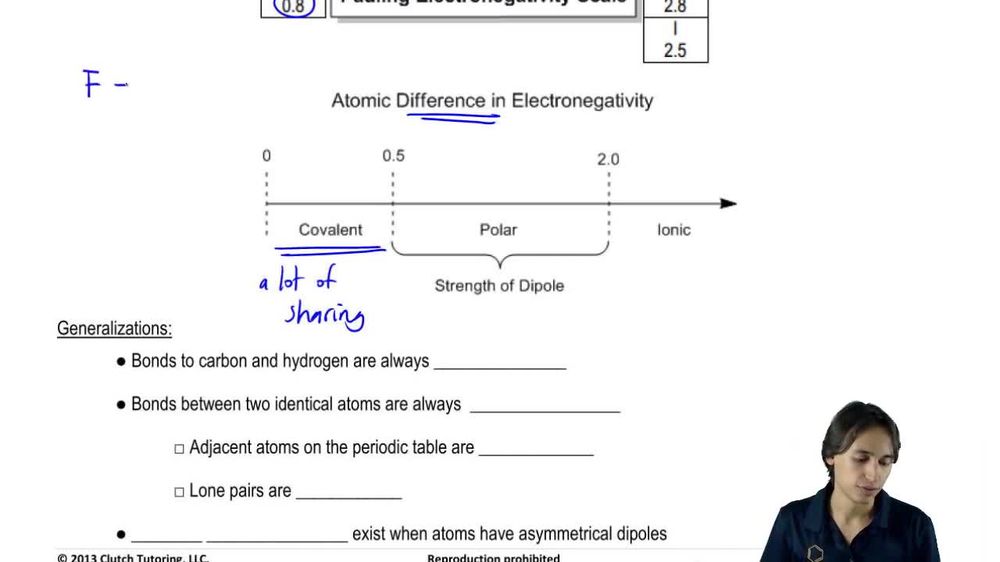
This video solution was recommended by our tutors as helpful for the problem above
Video duration:
4m
Play a video:
0 Comments
Key Concepts
Here are the essential concepts you must grasp in order to answer the question correctly.
Ionic Bonding
Ionic bonding occurs when atoms transfer electrons, resulting in the formation of charged ions. In sodium acetate, sodium (Na+) donates an electron to acetate (C2H3O2-), creating a strong electrostatic attraction between the oppositely charged ions. This strong attraction leads to the formation of a crystalline lattice structure, which contributes to the high melting point of ionic compounds.
Differences between ionic, polar and covalent bonds
Solubility in Water
Ionic compounds like sodium acetate are highly soluble in water due to the polar nature of water molecules. When ionic compounds dissolve, water molecules surround the individual ions, effectively separating them and allowing them to disperse in solution. This process, known as hydration, overcomes the ionic bonds in the solid, leading to high solubility despite the strong interactions present in the solid state.
The melting point of a substance is the temperature at which it transitions from a solid to a liquid. For ionic compounds, the melting point is typically high due to the strong ionic bonds that must be broken to allow the ions to move freely. In the case of sodium acetate, the high melting point reflects the stability of its ionic lattice, which requires significant energy to disrupt during the melting process.