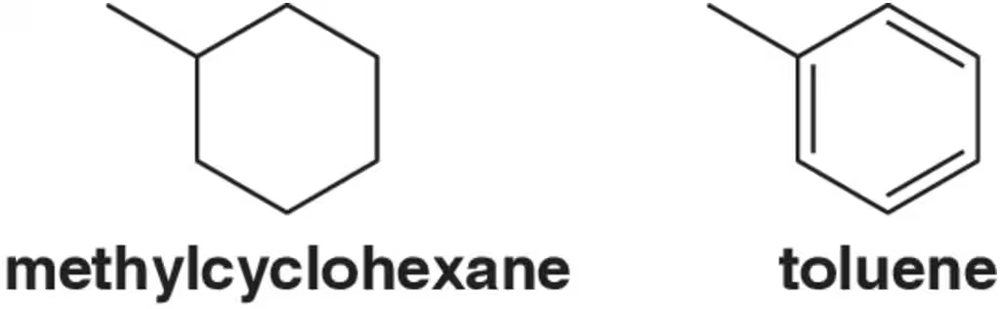
Despite methylcyclohexane (98.2 amu) having a higher molecular weight than toluene (92.1 amu), toluene melts at a higher temperature. Why? [Think about how the molecules can interact with each other based on their shape.]
Verified step by step guidance
1
Consider the molecular structures of methylcyclohexane and toluene. Methylcyclohexane is a saturated hydrocarbon (alkane) with a cyclohexane ring and a methyl group attached, while toluene is an aromatic compound with a benzene ring and a methyl group attached.
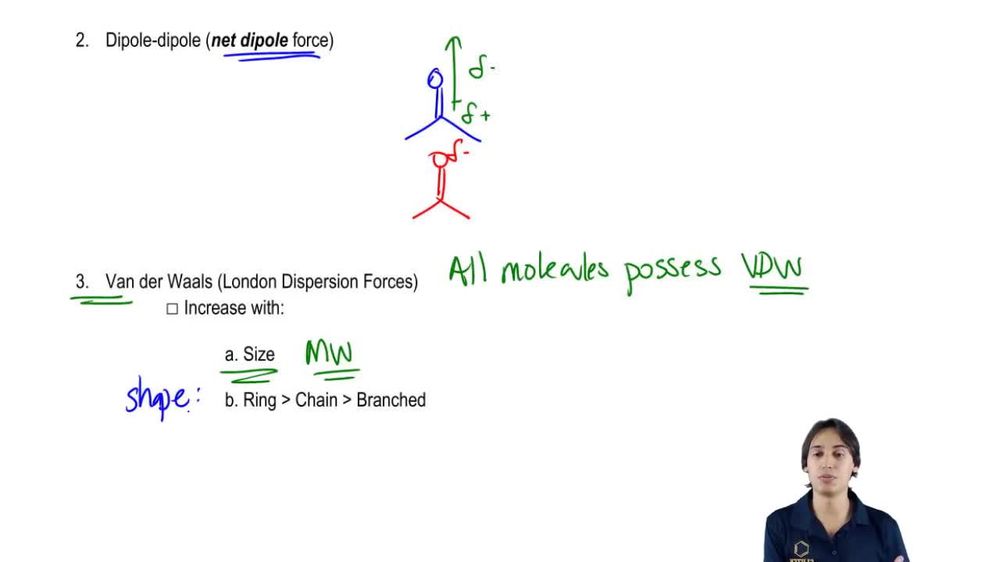
Analyze the intermolecular forces present in each molecule. Methylcyclohexane primarily exhibits London dispersion forces, which are relatively weak and depend on molecular size and shape. Toluene, on the other hand, has stronger π-π interactions due to the aromatic benzene ring.
Understand how molecular shape affects packing efficiency in the solid state. Toluene's flat, planar aromatic structure allows for better stacking and closer packing in the solid phase, which increases the melting point. Methylcyclohexane's non-planar, bulky structure reduces packing efficiency.
Consider the role of molecular weight. While methylcyclohexane has a slightly higher molecular weight, melting point is more influenced by intermolecular forces and molecular packing rather than molecular weight alone.
Conclude that the higher melting point of toluene is due to its stronger intermolecular forces (π-π interactions) and more efficient molecular packing in the solid state compared to methylcyclohexane.
Verified video answer for a similar problem:
This video solution was recommended by our tutors as helpful for the problem above
Video duration:
3m
Play a video:
0 Comments
Key Concepts
Here are the essential concepts you must grasp in order to answer the question correctly.
Molecular Weight vs. Melting Point
Molecular weight is the sum of the atomic weights of all atoms in a molecule, but it does not directly correlate with melting point. Melting point is influenced by intermolecular forces, such as hydrogen bonding, dipole-dipole interactions, and London dispersion forces. Thus, a compound with a higher molecular weight may not necessarily have a higher melting point if its intermolecular interactions are weaker.
How IMFs are related to melting and boiling points.
Molecular Shape and Interactions
The shape of a molecule affects how closely molecules can pack together, influencing their physical properties. Toluene, being a more symmetrical and planar molecule, can stack more efficiently than the bulky methylcyclohexane. This efficient packing leads to stronger van der Waals forces in toluene, contributing to its higher melting point despite its lower molecular weight.
Intermolecular forces are the forces of attraction between molecules, which play a crucial role in determining physical properties like melting and boiling points. Toluene exhibits stronger dipole-dipole interactions due to its polar C-H bonds, while methylcyclohexane's interactions are primarily due to weaker London dispersion forces. The strength and type of these forces significantly influence the melting behavior of the substances.