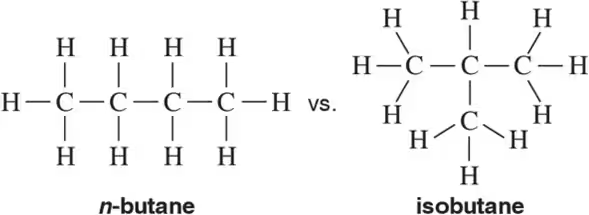
Choose the molecule in each pair you'd expect to have the higher boiling point. Explain your reasoning. (b)
Verified step by step guidance
1
Step 1: Understand the factors that influence boiling points. Boiling points are primarily affected by intermolecular forces, molecular weight, and molecular structure. Stronger intermolecular forces (e.g., hydrogen bonding, dipole-dipole interactions, and London dispersion forces) lead to higher boiling points.
Step 2: Identify the types of intermolecular forces present in each molecule of the pair. For example, check if the molecules can form hydrogen bonds (e.g., presence of -OH or -NH groups), have polar bonds (dipole-dipole interactions), or are nonpolar (relying on London dispersion forces).
Step 3: Compare the molecular weights of the two molecules. If the intermolecular forces are similar, the molecule with the higher molecular weight will generally have a higher boiling point due to increased London dispersion forces.
Step 4: Consider the molecular structure. Linear molecules tend to have higher boiling points than branched molecules of similar molecular weight because they have a larger surface area for intermolecular interactions.
Step 5: Based on the analysis of intermolecular forces, molecular weight, and structure, determine which molecule in the pair has the higher boiling point and explain your reasoning clearly.
Verified video answer for a similar problem:

This video solution was recommended by our tutors as helpful for the problem above
Video duration:
4m
Play a video:
0 Comments
Key Concepts
Here are the essential concepts you must grasp in order to answer the question correctly.
Intermolecular Forces
Intermolecular forces are the attractive forces between molecules that influence physical properties like boiling points. The main types include hydrogen bonding, dipole-dipole interactions, and London dispersion forces. Molecules with stronger intermolecular forces generally have higher boiling points because more energy is required to separate them during the phase change from liquid to gas.
Molecular weight, or molar mass, refers to the mass of a molecule based on the sum of the atomic weights of its constituent atoms. Generally, larger molecules with higher molecular weights exhibit higher boiling points due to increased London dispersion forces, which arise from temporary dipoles that occur in larger electron clouds. Thus, comparing molecular weights can provide insight into boiling point trends.
Polarity describes the distribution of electrical charge over the atoms in a molecule. Polar molecules have a significant difference in electronegativity between bonded atoms, leading to dipole moments. Polar molecules typically have higher boiling points than nonpolar molecules of similar size due to stronger dipole-dipole interactions, which require more energy to overcome during boiling.