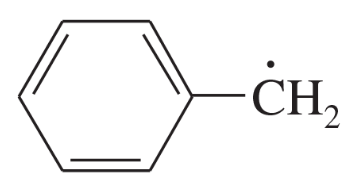
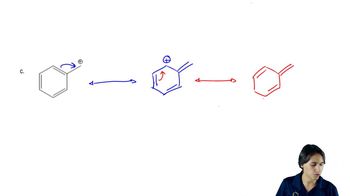
Draw the important resonance contributors for the following cations, anions, and radicals. (b)
Verified step by step guidance
1
Identify the structure of the given species (cation, anion, or radical) and locate any atoms with lone pairs, π-bonds, or unfilled octets. These features are key to determining resonance contributors.
Determine the movement of electrons. For resonance structures, electrons can move in the form of lone pairs or π-bonds. Use curved arrows to show the movement of electrons from one location to another.
Draw the new resonance structure after the electron movement. Ensure that the formal charges on atoms are updated correctly based on the electron redistribution.
Repeat the process to identify all possible resonance contributors. Remember that resonance structures must follow the rules of valence and cannot violate the octet rule (except for elements that can expand their octet, such as sulfur or phosphorus).
Evaluate the stability of each resonance structure. More stable contributors will have minimal formal charges, complete octets, and place negative charges on more electronegative atoms or positive charges on less electronegative atoms.
Verified video answer for a similar problem:
This video solution was recommended by our tutors as helpful for the problem above
Video duration:
2m
Play a video:
0 Comments
Key Concepts
Here are the essential concepts you must grasp in order to answer the question correctly.
Resonance Structures
Resonance structures are different Lewis structures for a molecule or ion that show the same arrangement of atoms but differ in the placement of electrons. These structures help illustrate the delocalization of electrons within a molecule, which can stabilize cations, anions, and radicals. Understanding resonance is crucial for predicting the reactivity and stability of these species.
Cations are positively charged species formed by the loss of electrons. Their stability is influenced by factors such as the ability to delocalize positive charge through resonance and the electronegativity of surrounding atoms. More stable cations typically have resonance contributors that distribute the positive charge over multiple atoms, reducing the energy of the species.
Radicals are species with unpaired electrons, making them highly reactive. The stability of radicals can be enhanced through resonance, where the unpaired electron can be delocalized over adjacent atoms. This delocalization lowers the energy of the radical and makes it less reactive, which is essential for understanding their behavior in chemical reactions.