The reaction of tert-butyl chloride with methanol is found to follow the rate equation rate = kr[(CH3)3C—Cl] a. What is the kinetic order with respect to tert-butyl chloride?
Verified step by step guidance
1
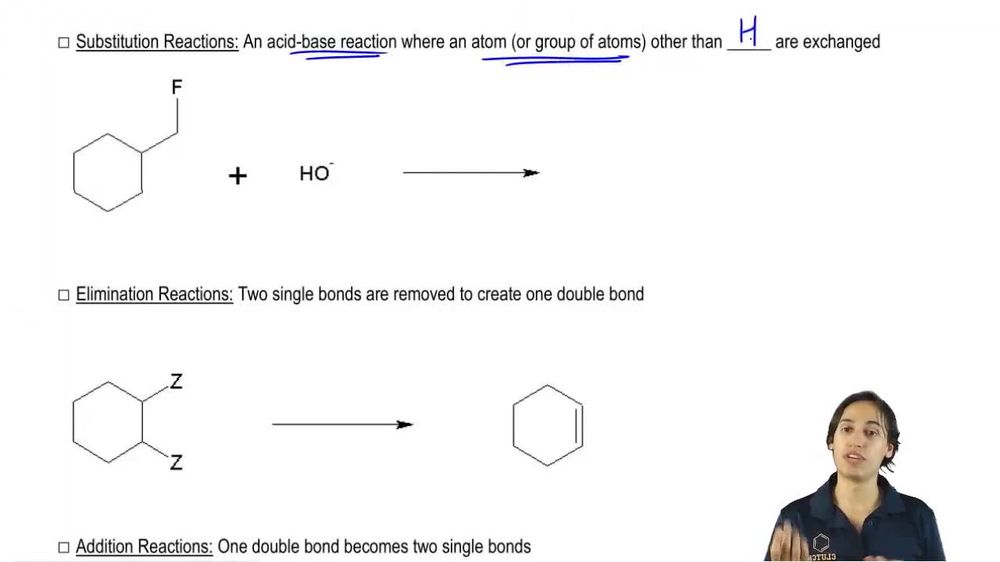
Step 1: Analyze the given reaction. The reaction involves tert-butyl chloride ((CH3)3C—Cl) reacting with methanol (CH3—OH) to form methyl tert-butyl ether ((CH3)3C—OCH3) and HCl. This is a substitution reaction.
Step 2: Examine the rate equation provided: rate = Kt[(CH3)3C—Cl]. The rate equation indicates that the rate of the reaction depends only on the concentration of tert-butyl chloride.
Step 3: Recall the definition of kinetic order. The kinetic order with respect to a reactant is determined by the exponent of its concentration term in the rate equation. Here, the concentration of tert-butyl chloride is raised to the power of 1.
Step 4: Conclude that the reaction is first-order with respect to tert-butyl chloride because the rate equation shows a direct proportionality to [(CH3)3C—Cl] raised to the power of 1.
Step 5: Note that this reaction likely proceeds via an SN1 mechanism, as the rate depends only on the concentration of tert-butyl chloride and not on methanol. This mechanism involves the formation of a carbocation intermediate.
Verified video answer for a similar problem:
This video solution was recommended by our tutors as helpful for the problem above
Video duration:
1m
Play a video:
0 Comments
Key Concepts
Here are the essential concepts you must grasp in order to answer the question correctly.
Kinetics and Rate Laws
Kinetics is the study of the rates of chemical reactions. The rate law expresses the relationship between the rate of a reaction and the concentration of its reactants. In this case, the rate equation indicates that the reaction rate depends only on the concentration of tert-butyl chloride, suggesting it is a first-order reaction with respect to this reactant.
The reaction of tert-butyl chloride with methanol is an example of a nucleophilic substitution reaction, where a nucleophile (methanol) replaces a leaving group (chloride ion). This type of reaction can proceed via different mechanisms, such as SN1 or SN2, with the SN1 mechanism being favored for tertiary alkyl halides like tert-butyl chloride due to steric hindrance.
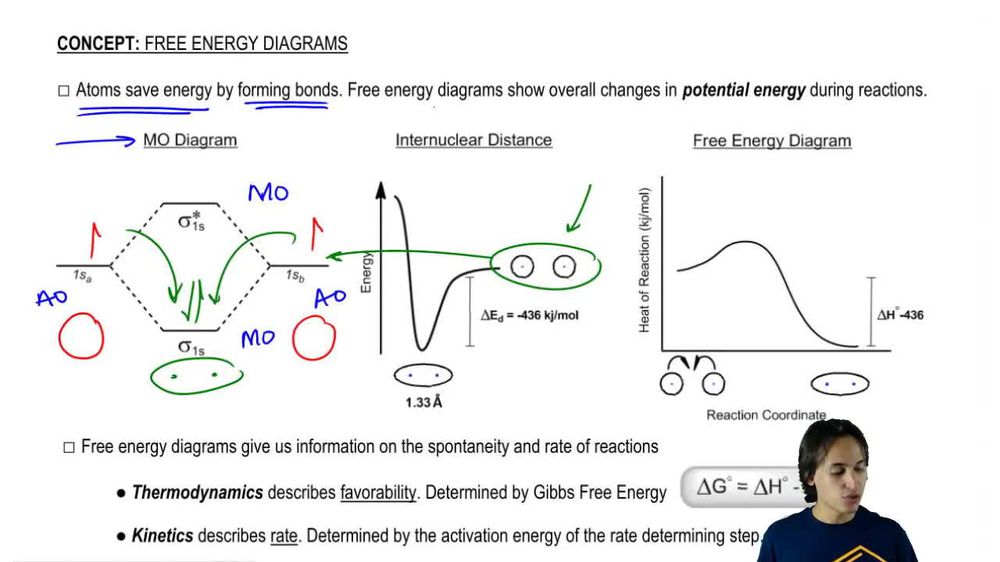
Energy diagrams visually represent the energy changes during a chemical reaction. They illustrate the transition states and intermediates, showing how the energy of the system changes from reactants to products. In this reaction, the energy diagram would depict the activation energy required for the formation of the carbocation intermediate, which is a key feature of the SN1 mechanism.