All things being equal, would you expect a first-order reaction to be faster or slower than a second-order reaction?
Verified step by step guidance
1
Understand the rate laws for first-order and second-order reactions. A first-order reaction has a rate law of the form: , while a second-order reaction has a rate law of the form: or .
Recognize that the reaction rate depends on both the rate constant () and the concentration of reactants. For a first-order reaction, the rate is directly proportional to the concentration of one reactant, while for a second-order reaction, the rate depends on the square of the concentration of one reactant or the product of two reactant concentrations.
Consider the effect of reactant concentration. At high concentrations, a second-order reaction can proceed faster than a first-order reaction because the rate depends on the square of the concentration or the product of two concentrations. However, as the concentration decreases, the rate of a second-order reaction decreases more rapidly than that of a first-order reaction.
Evaluate the role of the rate constant (). The magnitude of can vary depending on the specific reaction, so it is not possible to generalize whether a first-order or second-order reaction is inherently faster without knowing the value of .
Conclude that all things being equal (e.g., similar concentrations and rate constants), a second-order reaction may initially be faster due to its dependence on higher powers of concentration, but it will slow down more quickly as the reactants are consumed compared to a first-order reaction.
Verified video answer for a similar problem:
This video solution was recommended by our tutors as helpful for the problem above
Video duration:
4m
Play a video:
0 Comments
Key Concepts
Here are the essential concepts you must grasp in order to answer the question correctly.
Reaction Order
Reaction order refers to the power to which the concentration of a reactant is raised in the rate law of a chemical reaction. A first-order reaction depends linearly on the concentration of one reactant, while a second-order reaction depends on the square of the concentration of one reactant or the product of the concentrations of two reactants. Understanding reaction order is crucial for predicting how changes in concentration affect the rate of a reaction.
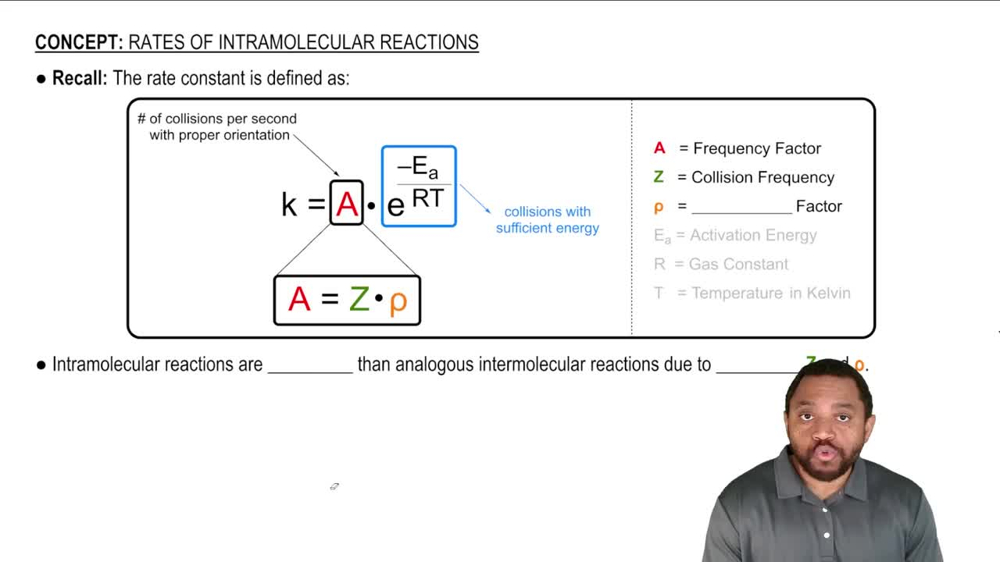
The rate constant (k) is a proportionality factor in the rate law that is specific to a given reaction at a certain temperature. For first-order reactions, the rate constant has units of time⁻¹, while for second-order reactions, it has units of concentration⁻¹ time⁻¹. The value of the rate constant influences how quickly a reaction proceeds, with first-order reactions generally being faster due to their simpler dependence on concentration.
Half-life is the time required for the concentration of a reactant to decrease to half of its initial value. For first-order reactions, the half-life is constant and independent of concentration, while for second-order reactions, it increases with decreasing concentration. This difference in half-life behavior is significant when comparing the speed of reactions, as first-order reactions typically exhibit shorter half-lives, leading to faster overall reaction rates.

 4:51 minutes
 Verified step by step guidance
 01:42
01:42