When a small piece of platinum is added to a mixture of ethene and hydrogen, the following reaction occurs: Ethene Doubling the concentration of hydrogen has no effect on the reaction rate. Doubling the concentration of ethene also has no effect. a. What is the kinetic order of this reaction with respect to ethene? With respect to hydrogen? What is the overall order?
Verified step by step guidance
1
Step 1: Analyze the reaction provided. The reaction involves ethene (C₂H₄) reacting with hydrogen (H₂) in the presence of a platinum catalyst to form ethane (C₂H₆). This is a catalytic hydrogenation reaction where the double bond in ethene is converted into a single bond in ethane.
Step 2: Understand the experimental observation. Doubling the concentration of ethene or hydrogen has no effect on the reaction rate. This indicates that the reaction rate is independent of the concentrations of these reactants.
Step 3: Recall the concept of reaction order. The kinetic order of a reaction with respect to a reactant is determined by how the rate of reaction changes with the concentration of that reactant. If the rate does not change when the concentration of a reactant is altered, the reaction is zero-order with respect to that reactant.
Step 4: Determine the kinetic order for each reactant. Since the rate is unaffected by changes in the concentration of ethene, the reaction is zero-order with respect to ethene. Similarly, since the rate is unaffected by changes in the concentration of hydrogen, the reaction is zero-order with respect to hydrogen.
Step 5: Calculate the overall order of the reaction. The overall order of a reaction is the sum of the orders with respect to each reactant. Since the reaction is zero-order with respect to both ethene and hydrogen, the overall order of the reaction is 0.
Verified video answer for a similar problem:
This video solution was recommended by our tutors as helpful for the problem above
Video duration:
2m
Play a video:
0 Comments
Key Concepts
Here are the essential concepts you must grasp in order to answer the question correctly.
Kinetics and Reaction Order
Kinetics is the study of the rates of chemical reactions and the factors that affect them. The reaction order refers to the power to which the concentration of a reactant is raised in the rate law. It indicates how the rate of reaction is affected by the concentration of reactants. In this case, since doubling the concentrations of both ethene and hydrogen does not change the reaction rate, the reaction is zero-order with respect to both reactants.
Catalysis involves the acceleration of a chemical reaction by a substance called a catalyst, which is not consumed in the reaction. In this scenario, platinum acts as a catalyst for the hydrogenation of ethene to ethane. The presence of the catalyst lowers the activation energy required for the reaction, allowing it to proceed more quickly without affecting the overall stoichiometry or the reaction order.
A zero-order reaction is one where the rate of reaction is constant and independent of the concentration of the reactants. This means that changes in the concentration of the reactants do not affect the rate of the reaction. In the context of the question, since increasing the concentrations of ethene and hydrogen does not alter the reaction rate, it indicates that the reaction is zero-order with respect to both reactants, leading to an overall zero-order reaction.

 2:26 minutes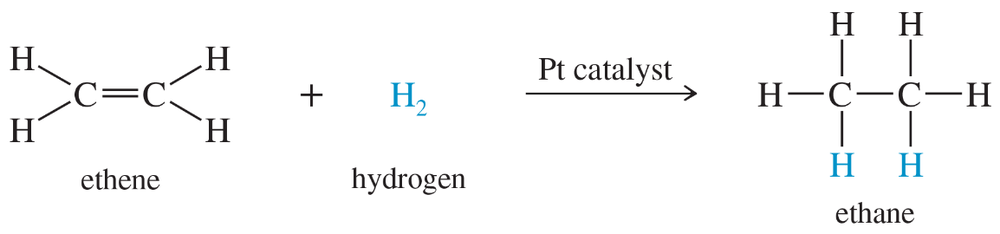
 Verified step by step guidance
 08:51
08:51