Ch. 19 - More About Amines • Reactions of Heterocyclic Compounds
Bruice - Organic Chemistry 8th Edition
Bruice8th EditionOrganic ChemistryISBN: 9780135213711Not the one you use?Change textbook
Chapter 20, Problem 7

Explain why cyclopentadiene (pKa = 15) is more acidic than pyrrole (pKa ∼17), even though nitrogen is more electronegative than carbon.

Verified step by step guidance
1
Step 1: Begin by analyzing the acidity of cyclopentadiene and pyrrole. Acidity is determined by the stability of the conjugate base formed after deprotonation. Cyclopentadiene forms a cyclopentadienyl anion, while pyrrole forms a pyrrole anion.
Step 2: Examine the conjugate base of cyclopentadiene, the cyclopentadienyl anion. This anion is aromatic because it follows Hückel's rule (4n+2 π electrons, where n=1). Aromaticity provides significant stabilization to the conjugate base, making cyclopentadiene more acidic.
Step 3: Analyze the conjugate base of pyrrole, the pyrrole anion. Deprotonation of pyrrole disrupts the aromaticity of the molecule because the lone pair on nitrogen becomes part of the π system, breaking the 4n+2 π electron rule. This loss of aromaticity makes the pyrrole anion less stable.
Step 4: Consider the role of electronegativity. While nitrogen is more electronegative than carbon, the stabilization provided by aromaticity in cyclopentadiene outweighs the electronegativity factor in pyrrole. Thus, cyclopentadiene is more acidic.
Step 5: Conclude that the difference in acidity between cyclopentadiene and pyrrole is primarily due to the aromatic stabilization of the cyclopentadienyl anion, which is absent in the pyrrole anion.

Verified video answer for a similar problem:

This video solution was recommended by our tutors as helpful for the problem above.
Video duration:
7m
Was this helpful?

Key Concepts

Here are the essential concepts you must grasp in order to answer the question correctly.

Acidity and pKa

Acidity in organic chemistry is often measured by the pKa value, which indicates the strength of an acid. A lower pKa value corresponds to a stronger acid, meaning it more readily donates protons (H+). Cyclopentadiene has a pKa of 15, making it a stronger acid than pyrrole, which has a pKa of approximately 17. This difference in acidity can be attributed to the stability of the resulting conjugate bases after deprotonation.
Recommended video:
Guided course
07:45
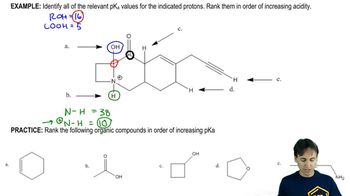
Identifying pKa values

Resonance Stabilization

Resonance stabilization occurs when a molecule can be represented by multiple valid Lewis structures, allowing for the delocalization of electrons. In the case of cyclopentadiene, the conjugate base formed after deprotonation is resonance-stabilized, distributing the negative charge over several atoms. In contrast, the conjugate base of pyrrole is less stable due to the presence of the nitrogen atom, which, while electronegative, does not stabilize the negative charge as effectively as the carbon framework in cyclopentadiene.
Recommended video:
Guided course
03:43
The radical stability trend.

Electronegativity and Charge Distribution

Electronegativity refers to the tendency of an atom to attract electrons towards itself. Although nitrogen is more electronegative than carbon, which suggests it would stabilize negative charges better, in pyrrole, the nitrogen's lone pair participates in the aromatic system, reducing its ability to stabilize the negative charge in the conjugate base. This contrasts with cyclopentadiene, where the negative charge in the conjugate base is more effectively delocalized, leading to greater acidity despite carbon's lower electronegativity.
Recommended video:
Guided course
1:47
Electronegativity