What reagents would you use for the following syntheses? c. hexane from 3-hexyne
Verified step by step guidance
1
Step 1: Recognize that the goal is to convert 3-hexyne (an alkyne) into hexane (an alkane). This requires a complete reduction of the triple bond to a single bond.
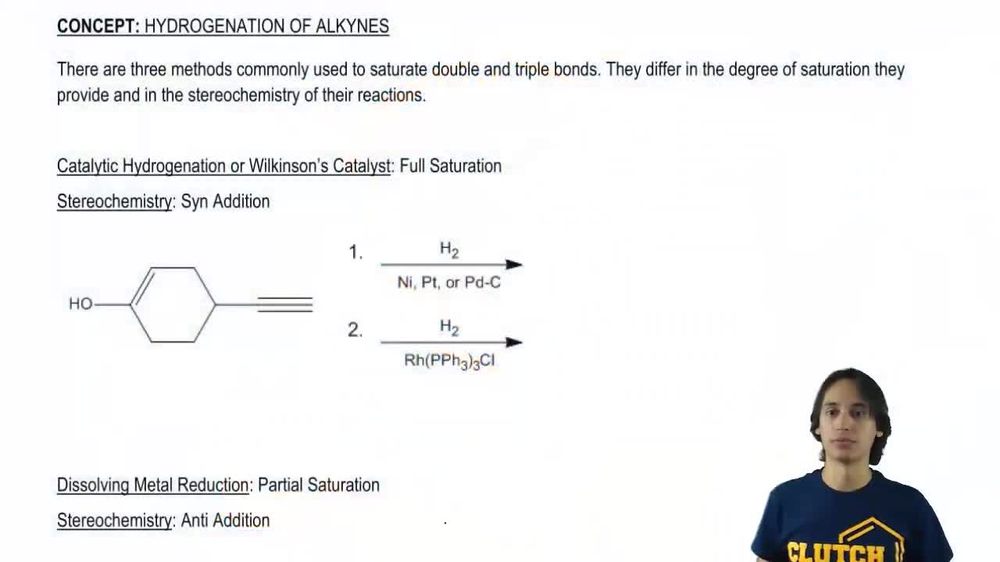
Step 2: Understand that the reduction of an alkyne to an alkane can be achieved using hydrogen gas (H₂) in the presence of a metal catalyst, such as palladium (Pd) or platinum (Pt). This process is known as catalytic hydrogenation.
Step 3: Note that the reaction typically proceeds in two stages: first, the alkyne is reduced to an alkene, and then the alkene is further reduced to an alkane. Using excess hydrogen gas ensures the reaction goes all the way to the alkane stage.
Step 4: Write the chemical equation for the reaction: . This shows the addition of hydrogen molecules to the alkyne to form hexane.
Step 5: Summarize the reagents needed: Use hydrogen gas (H₂) and a metal catalyst such as palladium (Pd) or platinum (Pt) under appropriate conditions (e.g., room temperature and pressure or slightly elevated conditions).
Verified video answer for a similar problem:
This video solution was recommended by our tutors as helpful for the problem above
Video duration:
2m
Play a video:
0 Comments
Key Concepts
Here are the essential concepts you must grasp in order to answer the question correctly.
Alkyne Reduction
Alkynes can be reduced to alkanes through various methods, typically involving hydrogenation. In this process, the triple bond of the alkyne is converted into a single bond, resulting in the formation of an alkane. Common reagents for this transformation include hydrogen gas (H2) in the presence of a catalyst such as palladium, platinum, or nickel.
Choosing the correct reagents is crucial for successful organic synthesis. In the case of synthesizing hexane from 3-hexyne, one would typically use hydrogenation reagents. Understanding the reactivity and selectivity of these reagents helps in determining the most efficient pathway for the desired product.
Synthesis of Amino Acids: Strecker Synthesis Example 1
Mechanism of Hydrogenation
The mechanism of hydrogenation involves the adsorption of the alkyne onto the surface of the metal catalyst, followed by the addition of hydrogen atoms across the triple bond. This process is stereospecific and can lead to the formation of different isomers depending on the conditions used. Familiarity with this mechanism is essential for predicting the outcome of the reaction.

 2:26 minutes
 Verified step by step guidance
 04:40
04:40