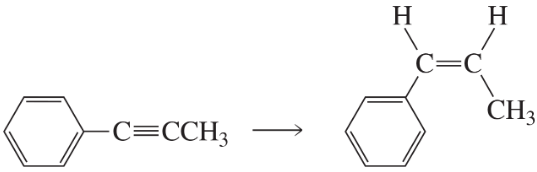
Show how each of the following compounds can be prepared using the given starting material, any needed inorganic reagents, and any organic compound that has no more than four carbons: f.
Verified step by step guidance
1
Step 1: Analyze the starting material and the target compound. The starting material is phenylpropyne (C≡CCH₃ attached to a benzene ring), and the target compound is phenylpropene (C=CCH₃ attached to a benzene ring). This transformation involves converting a triple bond into a double bond.
Step 2: Recognize the type of reaction needed. The conversion of an alkyne to an alkene can be achieved through a partial hydrogenation reaction. This requires a catalyst that selectively stops at the alkene stage rather than fully hydrogenating to an alkane.
Step 3: Choose the appropriate reagents. Use H₂ gas along with a Lindlar catalyst (a palladium catalyst poisoned with lead or quinoline). This combination ensures that the alkyne is reduced to a cis-alkene without further reduction to an alkane.
Step 4: Describe the reaction mechanism. The Lindlar catalyst facilitates the addition of hydrogen atoms to the triple bond, converting it into a double bond. The reaction stops at the alkene stage due to the poisoned catalyst, which prevents over-reduction.
Step 5: Verify the product. The resulting compound will be phenylpropene with a cis configuration (both hydrogens on the same side of the double bond). This matches the target compound shown in the problem.
Verified video answer for a similar problem:
This video solution was recommended by our tutors as helpful for the problem above
Video duration:
1m
Play a video:
0 Comments
Key Concepts
Here are the essential concepts you must grasp in order to answer the question correctly.
Functional Groups
Functional groups are specific groups of atoms within molecules that are responsible for the characteristic chemical reactions of those molecules. Understanding the functional groups present in both the starting materials and the target compounds is essential for predicting the types of reactions that can occur during synthesis.
Reaction mechanisms describe the step-by-step process by which reactants are converted into products. Familiarity with common mechanisms, such as nucleophilic substitution or elimination reactions, is crucial for determining how to effectively transform the starting material into the desired compound using the appropriate reagents.
Choosing the right reagents is vital for successful organic synthesis. This involves understanding the reactivity of various inorganic and organic compounds, as well as how they interact with the starting material to facilitate the desired transformations while adhering to the constraints of the problem, such as the carbon limit.