Ch. 28 - Pericyclic Reactions
Bruice - Organic Chemistry 8th Edition
Bruice8th EditionOrganic ChemistryISBN: 9780135213711Not the one you use?Change textbook
Chapter 25, Problem 5

a. For conjugated systems with two, three, four, five, six, and seven conjugated p-bonds, construct quick MOs (just draw the lobes at the ends of the conjugated system as they are drawn on pages 1220 and 1221) to show whether the HOMO is symmetric or antisymmetric.
b. Using these drawings, convince yourself that the Woodward–Hoffmann rules in Table 28.1 are valid.

Verified step by step guidance
1
Step 1: Understand the problem. The question involves constructing molecular orbitals (MOs) for conjugated systems with varying numbers of conjugated π-bonds and determining whether the highest occupied molecular orbital (HOMO) is symmetric or antisymmetric. Additionally, you need to relate this to the Woodward–Hoffmann rules, which describe the symmetry of orbitals in pericyclic reactions.
Step 2: Recall the key concept of molecular orbitals in conjugated systems. For a conjugated system with n π-bonds, there are n molecular orbitals. These orbitals are formed by the linear combination of atomic p-orbitals, and their symmetry alternates between symmetric and antisymmetric as you move up in energy levels. The HOMO is the highest energy orbital that is fully occupied.
Step 3: Draw the molecular orbitals for each system. For example, for a system with two π-bonds, there are two MOs: one bonding (symmetric) and one antibonding (antisymmetric). For three π-bonds, there are three MOs: one bonding (symmetric), one non-bonding (antisymmetric), and one antibonding (symmetric). Continue this process for systems with four, five, six, and seven π-bonds, ensuring you alternate symmetry as you move up in energy levels.
Step 4: Identify the HOMO for each system. The HOMO is the highest energy orbital that is fully occupied. For systems with an even number of π-bonds, the HOMO will be symmetric. For systems with an odd number of π-bonds, the HOMO will be antisymmetric. This pattern arises from the alternating symmetry of the molecular orbitals.
Step 5: Relate the findings to the Woodward–Hoffmann rules. The Woodward–Hoffmann rules state that the symmetry of the HOMO determines whether a pericyclic reaction is allowed under thermal or photochemical conditions. By observing the symmetry of the HOMO in each case, you can confirm that the rules in Table 28.1 are consistent with the molecular orbital symmetries you have drawn.

Verified video answer for a similar problem:

This video solution was recommended by our tutors as helpful for the problem above.
Video duration:
11m
Was this helpful?

Key Concepts

Here are the essential concepts you must grasp in order to answer the question correctly.

Conjugated Systems

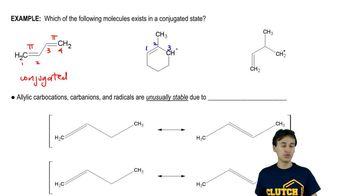
Conjugated systems consist of alternating single and multiple bonds, allowing for delocalization of π electrons across adjacent p-orbitals. This delocalization leads to unique electronic properties and stability, influencing the reactivity and spectral characteristics of the molecule. Understanding the arrangement and number of conjugated p-bonds is crucial for predicting molecular orbital (MO) behavior.
Recommended video:
Guided course
03:27
Conjugated states

Molecular Orbitals (MOs)

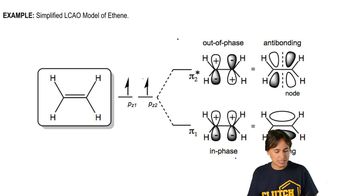
Molecular orbitals are formed by the linear combination of atomic orbitals (LCAO) and describe the distribution of electrons in a molecule. In conjugated systems, MOs can be classified as bonding, non-bonding, or antibonding, with the highest occupied molecular orbital (HOMO) being particularly important for understanding reactivity. The symmetry of the HOMO can indicate how the molecule will interact with other species during reactions.
Recommended video:
Guided course
08:41
Review of Molecular Orbitals

Woodward–Hoffmann Rules

The Woodward–Hoffmann rules provide a framework for predicting the outcomes of pericyclic reactions based on the symmetry properties of MOs. These rules state that the allowed or forbidden nature of a reaction can be determined by the symmetry of the HOMO and the lowest unoccupied molecular orbital (LUMO). By analyzing the symmetry of MOs in conjugated systems, one can validate these rules and predict the feasibility of specific reactions.
Recommended video:
1:18
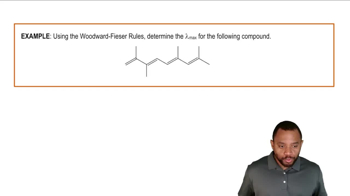
Woodward-Fieser Rules Example 1