Write a balanced equation for each reaction, showing the major product you expect. (d)
Verified step by step guidance
1
Step 1: Identify the type of reaction. The presence of NaOH and heat suggests an elimination reaction (E2 mechanism), where the alkyl halide undergoes dehydrohalogenation to form an alkene.
Step 2: Analyze the structure of the starting material, CH3CH(CH3)C(CH3)2Br. The bromine atom is attached to a tertiary carbon, which is highly favorable for elimination reactions due to steric hindrance.
Step 3: Determine the possible β-hydrogens available for elimination. The β-hydrogens are located on the carbons adjacent to the carbon bonded to the bromine atom. In this case, there are β-hydrogens on the methyl groups and the ethyl group.
Step 4: Apply Zaitsev's rule to predict the major product. Zaitsev's rule states that the most substituted alkene will be the major product. Elimination of a β-hydrogen from the ethyl group will result in the formation of the more substituted alkene.
Step 5: Write the balanced equation for the reaction. The bromine atom is removed, and a double bond is formed between the α-carbon (the carbon bonded to bromine) and the β-carbon (the carbon from which the hydrogen is eliminated). The major product is the more substituted alkene.
Verified video answer for a similar problem:
This video solution was recommended by our tutors as helpful for the problem above
Video duration:
6m
Play a video:
0 Comments
Key Concepts
Here are the essential concepts you must grasp in order to answer the question correctly.
Nucleophilic Substitution Reactions
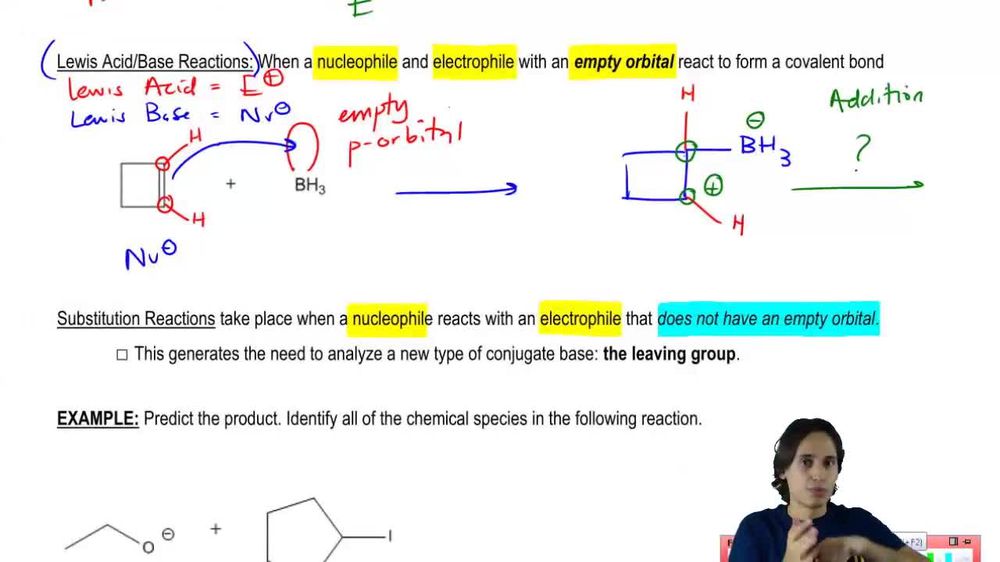
Nucleophilic substitution reactions involve the replacement of a leaving group (like Br) by a nucleophile (like OH- from NaOH). These reactions can proceed via two main mechanisms: SN1, which is unimolecular and involves a carbocation intermediate, and SN2, which is bimolecular and involves a direct attack by the nucleophile. The choice of mechanism depends on factors such as substrate structure and the strength of the nucleophile.
Nucleophiles and Electrophiles can react in Substitution Reactions.
Carbocation Stability
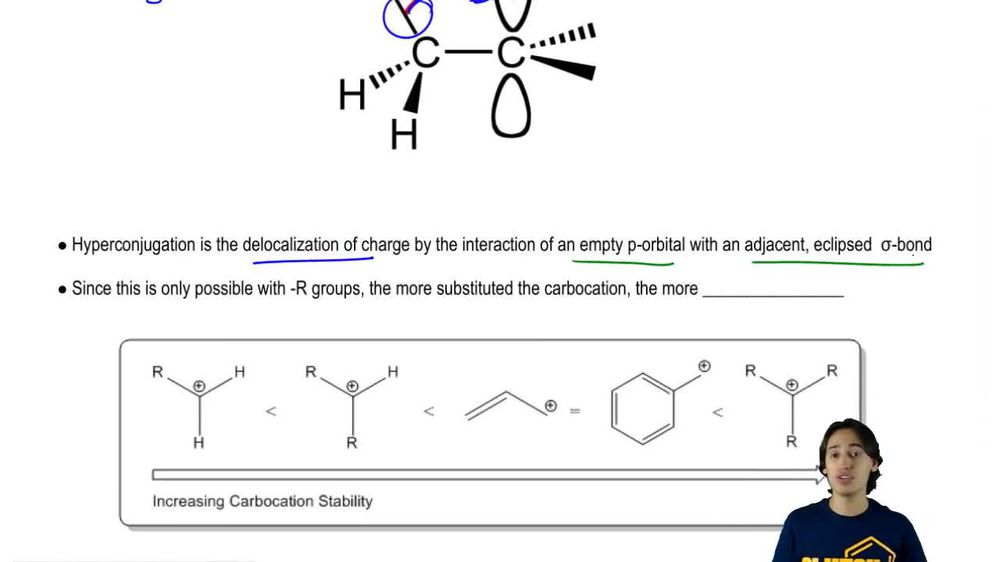
Carbocation stability is crucial in determining the pathway of nucleophilic substitution reactions. Tertiary carbocations are more stable than secondary or primary due to hyperconjugation and inductive effects from surrounding alkyl groups. In the given reaction, the presence of multiple alkyl groups adjacent to the carbocation can favor the SN1 mechanism, leading to the formation of a more stable intermediate before the nucleophile attacks.
The reaction conditions, including the use of heat, can influence the outcome of nucleophilic substitution reactions. Heating can favor elimination reactions or promote the formation of more stable products. In this case, heating the reaction with NaOH may enhance the likelihood of an SN1 pathway, allowing for the formation of a stable carbocation and subsequent product formation, rather than competing elimination reactions.

 6:13 minutes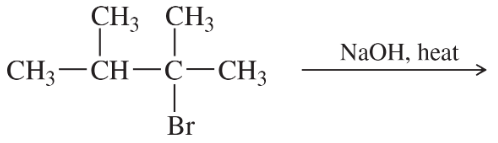
 Verified step by step guidance
 01:47
01:47