Ch. 7 - Structure and Synthesis of Alkenes; Elimination
Wade - Organic Chemistry 9th Edition
Wade9th EditionOrganic ChemistryISBN: 9780135213728Not the one you use?Change textbook
Chapter 7, Problem 67a

Pure (S)-2-bromo-2-fluorobutane reacts with methoxide ion in methanol to give a mixture of (S)-2-fluoro-2-methoxybutane and three fluoroalkenes.
a. Use mechanisms to show which three fluoroalkenes are formed.

Verified step by step guidance
1
Identify the type of reaction: The reaction involves a strong base (methoxide ion) and a secondary alkyl halide ((S)-2-bromo-2-fluorobutane). This suggests that both substitution (SN2 or SN1) and elimination (E2 or E1) mechanisms may occur. Analyze the conditions to determine the likely pathways.
Focus on the elimination (E2) mechanism: Methoxide ion is a strong base, favoring the E2 mechanism. In E2 elimination, a β-hydrogen is removed along with the leaving group (bromide ion) to form a double bond. Identify all β-hydrogens in (S)-2-bromo-2-fluorobutane and the possible alkenes that can form.
Determine the three fluoroalkenes: (1) Remove a β-hydrogen from the carbon adjacent to the carbon bearing the bromine atom. This can occur at two different β-carbons, leading to regioisomers. Additionally, for each regioisomer, consider the possibility of cis/trans (E/Z) stereoisomers due to restricted rotation around the double bond.
Explain the substitution product: The methoxide ion can also act as a nucleophile, displacing the bromide ion via an SN2 mechanism. This results in the formation of (S)-2-fluoro-2-methoxybutane. The stereochemistry of the product is retained because the reaction occurs at a stereocenter.
Summarize the products: The reaction yields one substitution product ((S)-2-fluoro-2-methoxybutane) and three fluoroalkenes (two regioisomers, one of which has cis/trans stereoisomers). Use curved-arrow mechanisms to illustrate the E2 and SN2 pathways, showing the movement of electrons and the formation of each product.

Verified video answer for a similar problem:

This video solution was recommended by our tutors as helpful for the problem above.
Video duration:
15m
Was this helpful?

Key Concepts

Here are the essential concepts you must grasp in order to answer the question correctly.

Nucleophilic Substitution Mechanisms

Nucleophilic substitution reactions involve the replacement of a leaving group by a nucleophile. In this case, the methoxide ion acts as a nucleophile attacking the carbon atom bonded to the bromine in (S)-2-bromo-2-fluorobutane. Understanding the mechanisms, such as SN1 and SN2, is crucial for predicting the products formed during the reaction.
Recommended video:
Guided course
01:47
Nucleophiles and Electrophiles can react in Substitution Reactions.

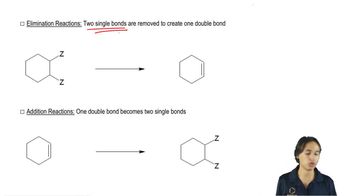
Elimination Reactions

Elimination reactions involve the removal of a leaving group and a hydrogen atom, resulting in the formation of a double bond. In the context of this reaction, the presence of methanol and the base (methoxide ion) can lead to elimination pathways, producing fluoroalkenes. Recognizing the conditions that favor elimination over substitution is essential for determining the products.
Recommended video:
Guided course
00:40
Recognizing Elimination Reactions.

Stereochemistry of Reactions

Stereochemistry refers to the spatial arrangement of atoms in molecules and how this affects their reactivity and the products formed. The starting material, (S)-2-bromo-2-fluorobutane, has specific stereochemical properties that influence the outcome of both substitution and elimination reactions. Understanding how stereochemistry impacts the formation of products, including the configuration of fluoroalkenes, is vital for accurate predictions.
Recommended video:
1:38
Polymer Stereochemistry Concept 1
Related Practice
Textbook Question

Protonation converts the hydroxy group of an alcohol to a good leaving group. Suggest a mechanism for each reaction.

(b)

2171
views

Textbook Question

a. Design an alkyl halide that will give only 2,4-diphenylpent-2-ene upon treatment with potassium tert-butoxide (a bulky base that promotes E2 elimination).

b. What stereochemistry is required in your alkyl halide so that only the following stereoisomer of the product is formed?

845
views
Textbook Question

When (±)−2,3−dibromobutane reacts with potassium hydroxide, some of the products are (2S,3R)-3-bromobutan-2-ol and its enantiomer and trans-2-bromobut-2-ene. Why is no cis-2-bromobut-2-ene formed?

972
views
Textbook Question

A chemist allows some pure (2S,3R)-3-bromo-2,3-diphenylpentane to react with a solution of sodium ethoxide (NaOCH2CH3) in ethanol. The products are two alkenes: A (cis-trans mixture) and B, a single pure isomer. Under the same conditions, the reaction of (2S,3S)-3-bromo-2,3-diphenylpentane gives two alkenes, A (cis-trans mixture) and C. Upon catalytic hydrogenation, all three of these alkenes (A, B, and C) give 2,3-diphenylpentane. Determine the structures of A, B, and C; give equations for their formation; and explain the stereospecificity of these reactions.

1654
views
Textbook Question

When (±)−2,3−dibromobutane reacts with potassium hydroxide, some of the products are (2S,3R)-3-bromobutan-2-ol and its enantiomer and trans-2-bromobut-2-ene. Give mechanisms to account for these products.

1243
views
Textbook Question

Pure (S)-2-bromo-2-fluorobutane reacts with methoxide ion in methanol to give a mixture of (S)-2-fluoro-2-methoxybutane and three fluoroalkenes.

b. Propose a mechanism to show how (S)-2-bromo-2-fluorobutane reacts to give (S)-2-fluoro-2-methoxybutane. Has this reaction gone with retention or inversion of configuration?

1669
views