After a proton is removed from the OH group, which compound in each pair forms a cyclic ether more rapidly? c.
Verified step by step guidance
1
Step 1: Analyze the chemical structures provided. Both compounds contain an OH group and a bromine atom (Br) attached to a carbon chain. The first compound has a shorter chain (6 carbons total), while the second compound has a longer chain (7 carbons total).
Step 2: Understand the reaction mechanism. The formation of a cyclic ether involves the removal of a proton from the OH group, followed by an intramolecular nucleophilic substitution where the oxygen attacks the carbon bonded to bromine, leading to the formation of a ring.
Step 3: Consider the size of the ring formed. The first compound forms a 5-membered ring upon cyclization, while the second compound forms a 6-membered ring. Generally, 5- and 6-membered rings are favored due to their stability, but 6-membered rings are slightly more stable due to reduced ring strain.
Step 4: Evaluate the rate of cyclization. The proximity of the OH group to the bromine atom affects the rate of reaction. In the first compound, the shorter chain allows for closer interaction between the nucleophile (oxygen) and the electrophile (carbon bonded to bromine), facilitating faster cyclization.
Step 5: Conclude which compound forms a cyclic ether more rapidly. Based on the shorter chain length and the ability to form a stable 5-membered ring, the first compound is expected to form a cyclic ether more rapidly than the second compound.
Verified video answer for a similar problem:
This video solution was recommended by our tutors as helpful for the problem above
Video duration:
4m
Play a video:
0 Comments
Key Concepts
Here are the essential concepts you must grasp in order to answer the question correctly.
Cyclic Ethers
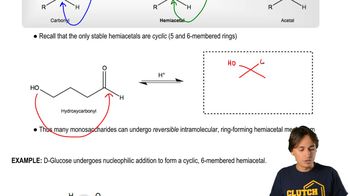
Cyclic ethers are a class of compounds characterized by a ring structure containing one or more oxygen atoms. They are formed through the reaction of alcohols or other compounds that can undergo intramolecular nucleophilic substitution. Understanding the stability and reactivity of cyclic ethers is crucial for predicting which compound will form more rapidly after a proton is removed from the OH group.
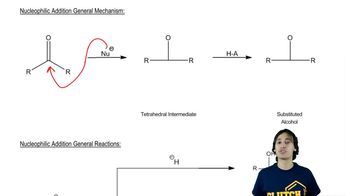
The removal of a proton from an OH group increases the nucleophilicity of the resulting alkoxide ion. This enhanced nucleophilicity allows the alkoxide to more readily attack an electrophile, facilitating the formation of cyclic ethers. Recognizing how proton removal affects nucleophilicity is essential for determining the reactivity of the compounds in question.
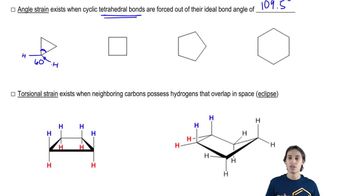
Ring strain refers to the increased energy and instability associated with smaller cyclic structures due to angle strain and torsional strain. In the context of cyclic ethers, compounds with less ring strain are generally more stable and can form more rapidly. Understanding the relationship between ring size, strain, and stability is important for predicting the kinetics of cyclic ether formation.