Show how you would accomplish the following conversions. c. trans-hex-3-ene to meso-hexane-3,4-diol
Verified step by step guidance
1
Step 1: Recognize that the conversion involves the addition of hydroxyl groups (-OH) to the double bond in trans-hex-3-ene, resulting in meso-hexane-3,4-diol. This is a dihydroxylation reaction.
Step 2: Select a reagent that performs syn-dihydroxylation, as meso compounds require the hydroxyl groups to be added on the same face of the molecule. A common reagent for this is osmium tetroxide (OsO₄) in the presence of a co-oxidant like NMO (N-methylmorpholine N-oxide). Alternatively, potassium permanganate (KMnO₄) under mild conditions can also be used.
Step 3: Apply the chosen reagent to trans-hex-3-ene. The syn-dihydroxylation will add hydroxyl groups to the 3rd and 4th carbons of the hexane chain, ensuring that both hydroxyl groups are on the same face of the molecule.
Step 4: Verify the stereochemistry of the product. Since the starting material is trans-hex-3-ene, the addition of hydroxyl groups in a syn fashion will result in a meso compound, as the molecule will have internal symmetry.
Step 5: Purify the product, meso-hexane-3,4-diol, using standard purification techniques such as recrystallization or chromatography, if necessary.
Verified video answer for a similar problem:
This video solution was recommended by our tutors as helpful for the problem above
Video duration:
6m
Play a video:
0 Comments
Key Concepts
Here are the essential concepts you must grasp in order to answer the question correctly.
Alkenes and Their Reactions
Alkenes are hydrocarbons that contain at least one carbon-carbon double bond. They are reactive due to the presence of this double bond, which can undergo various reactions such as hydrogenation, halogenation, and hydration. Understanding the reactivity of alkenes is crucial for predicting the products of reactions, such as converting trans-hex-3-ene into a diol.
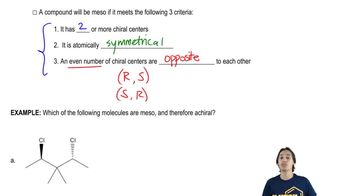
Stereochemistry involves the study of the spatial arrangement of atoms in molecules. Meso compounds are a specific type of stereoisomer that have multiple chiral centers but are achiral due to an internal plane of symmetry. Recognizing the formation of meso-hexane-3,4-diol from trans-hex-3-ene requires understanding how stereochemistry influences the final product's properties.
Hydroxylation is the addition of hydroxyl (–OH) groups to a compound, often occurring in the presence of reagents like osmium tetroxide or potassium permanganate. This reaction is significant in converting alkenes to diols, as seen in the transformation from trans-hex-3-ene to meso-hexane-3,4-diol. Mastery of hydroxylation mechanisms is essential for predicting and executing such conversions.