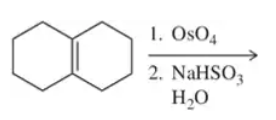
Predict the product(s) of each of the following reactions, making sure to indicate the relative stereochemical outcome. Indicate any racemic mixtures by drawing both enantiomers. (c)
Verified step by step guidance
1
Step 1: Recognize the reaction type. The reagents OsO₄ (osmium tetroxide) followed by NaHSO₃ and H₂O indicate a dihydroxylation reaction. This reaction adds two hydroxyl (-OH) groups to the double bond in a syn addition manner.
Step 2: Identify the structure of the starting material. The starting material is a bicyclic compound with a double bond in one of the rings. The double bond is the site of the reaction.
Step 3: Predict the stereochemical outcome. Osmium tetroxide adds hydroxyl groups to the same face of the double bond (syn addition). This means the two -OH groups will be added to the same side of the plane of the double bond.
Step 4: Draw the product. The double bond will be replaced by two hydroxyl groups (-OH) on the same face of the ring system. Since the molecule is symmetric, the product will not have enantiomers but will be a single stereoisomer.
Step 5: Confirm the reaction mechanism. The reaction proceeds through the formation of an osmate ester intermediate, which is then cleaved by NaHSO₃ and H₂O to yield the diol product.
Verified video answer for a similar problem:
This video solution was recommended by our tutors as helpful for the problem above
Video duration:
2m
Play a video:
0 Comments
Key Concepts
Here are the essential concepts you must grasp in order to answer the question correctly.
Dihydroxylation
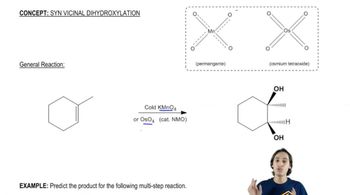
Dihydroxylation is a chemical reaction that involves the addition of two hydroxyl (–OH) groups to a double bond in an alkene. This reaction can be achieved through various methods, including the use of osmium tetroxide (OsO4), which forms a cyclic osmate ester intermediate. The subsequent hydrolysis of this intermediate leads to the formation of vicinal diols, which are compounds with hydroxyl groups on adjacent carbon atoms.
General properties of syn vicinal dihydroxylation.
Stereochemistry
Stereochemistry refers to the study of the spatial arrangement of atoms in molecules and how this arrangement affects their chemical behavior. In reactions like dihydroxylation, the stereochemical outcome is crucial, as the addition of hydroxyl groups can lead to the formation of chiral centers, resulting in enantiomers. Understanding stereochemistry helps predict the relative configurations of the products, such as whether they are enantiomers or diastereomers.
A racemic mixture is a 1:1 mixture of two enantiomers, which are molecules that are mirror images of each other but cannot be superimposed. In the context of dihydroxylation, if the reaction leads to the formation of a chiral product without a preference for one enantiomer over the other, a racemic mixture will be produced. This is important in organic synthesis, as the presence of both enantiomers can affect the biological activity and properties of the compound.