
Predict the major products of the following reactions, including stereochemistry where appropriate. (k) cyclopentanol + H2SO4/heat (l) product from (k) + OsO4/H2O2, then HIO4 (m) sodium ethoxide + 1-bromobutane
Verified step by step guidance
1
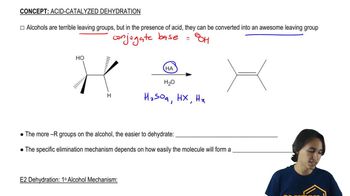
Step 1: For reaction (k), cyclopentanol reacts with H2SO4 and heat. This is an acid-catalyzed dehydration reaction. The hydroxyl group (-OH) is protonated by H2SO4, forming water as a leaving group. The cyclopentanol undergoes elimination to form cyclopentene as the major product. Ensure to consider the formation of the double bond and stereochemistry if applicable.
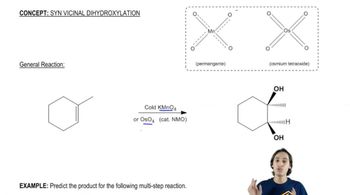
Step 2: For reaction (l), the product from (k), cyclopentene, reacts with OsO4 and H2O2. This is a dihydroxylation reaction, where OsO4 adds two hydroxyl groups (-OH) to the double bond in a syn addition manner, forming a cis-1,2-diol. Then, HIO4 cleaves the diol via oxidative cleavage, breaking the C-C bond between the hydroxyl groups and forming aldehydes or ketones as products. Carefully analyze the structure to predict the cleavage products.
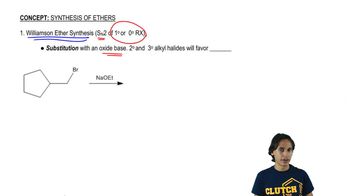
Step 3: For reaction (m), sodium ethoxide (NaOEt) reacts with 1-bromobutane. This is an example of an SN2 reaction mechanism, where the nucleophile (ethoxide ion, CH3CH2O⁻) attacks the electrophilic carbon attached to the bromine atom in 1-bromobutane. Bromine leaves as a leaving group, and the ethoxide ion replaces it, forming ethylbutane. Consider the stereochemistry of the SN2 reaction, which involves inversion of configuration at the carbon center.
Step 4: Review the stereochemistry for each reaction. For (k), the stereochemistry of the double bond in cyclopentene is not relevant as it is a planar molecule. For (l), ensure the syn addition of hydroxyl groups during dihydroxylation and the cleavage products from HIO4. For (m), confirm the inversion of configuration due to the SN2 mechanism.
Step 5: Summarize the major products for each reaction: (k) cyclopentene, (l) aldehydes/ketones from oxidative cleavage, and (m) ethylbutane. Ensure to verify the reaction mechanisms and stereochemical outcomes for accuracy.
Verified video answer for a similar problem:
This video solution was recommended by our tutors as helpful for the problem above
Video duration:
6m
Play a video:
0 Comments
Key Concepts
Here are the essential concepts you must grasp in order to answer the question correctly.
Acid-Catalyzed Dehydration
In the presence of an acid like H2SO4, alcohols can undergo dehydration to form alkenes. This reaction involves the protonation of the alcohol, leading to the formation of a carbocation, which can then lose a water molecule. The stability of the carbocation and the possibility of rearrangements are crucial for predicting the major product and its stereochemistry.
The reaction of alkenes with OsO4 followed by H2O2 leads to syn-dihydroxylation, adding hydroxyl groups across the double bond. Subsequent treatment with HIO4 cleaves the resulting diol, producing carbonyl compounds. Understanding the stereochemistry of the initial dihydroxylation is essential for predicting the final products after cleavage.
General properties of syn vicinal dihydroxylation.
Williamson Ether Synthesis
The reaction between sodium ethoxide and 1-bromobutane exemplifies the Williamson ether synthesis, where an alkoxide ion acts as a nucleophile to attack a primary alkyl halide. This reaction typically proceeds via an SN2 mechanism, leading to the formation of an ether. Recognizing the mechanism and the nature of the reactants is vital for predicting the product structure.