Predict the product(s) that would result when molecules (a)–(p) are allowed to react under the following conditions: (xi) HOCl, H₂O (xii) HIO₄. If no reaction occurs, write 'no reaction.' (a)
Verified step by step guidance
1
Identify the functional group in the given molecule. The structure shown is benzyl alcohol, which contains a primary alcohol group attached to a benzene ring.
Consider the reaction with HOCl, H₂O. HOCl is a source of hypochlorous acid, which can oxidize primary alcohols to aldehydes or carboxylic acids under certain conditions.
Predict the product of the reaction with HOCl, H₂O. In this case, the primary alcohol group in benzyl alcohol is likely to be oxidized to a carboxylic acid, resulting in benzoic acid.
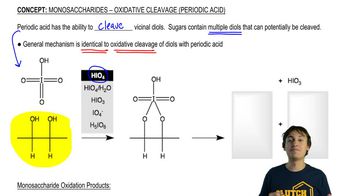
Consider the reaction with HIO₄. Periodic acid (HIO₄) is typically used to cleave vicinal diols (1,2-diols) into aldehydes or ketones. Since benzyl alcohol does not contain a vicinal diol, no reaction is expected with HIO₄.
Summarize the expected outcomes: The reaction with HOCl, H₂O will likely yield benzoic acid, while the reaction with HIO₄ will result in 'no reaction' as there is no vicinal diol present in the molecule.
Verified video answer for a similar problem:
This video solution was recommended by our tutors as helpful for the problem above
Play a video:
Was this helpful?
Key Concepts
Here are the essential concepts you must grasp in order to answer the question correctly.
Electrophilic Aromatic Substitution
Electrophilic aromatic substitution (EAS) is a reaction in which an electrophile replaces a hydrogen atom on an aromatic ring. In the context of phenol, the hydroxyl group activates the benzene ring towards electrophilic attack, making it more reactive. The presence of HOCl can lead to chlorination of the aromatic ring, typically at the ortho or para position relative to the hydroxyl group.
HIO₄ is a reagent used for oxidative cleavage of vicinal diols, breaking the C-C bond between them to form carbonyl compounds. However, in the case of phenol, there are no vicinal diols present, so HIO₄ would not react with the structure. Therefore, no reaction is expected when phenol is treated with HIO₄.
Phenol is an aromatic compound with a hydroxyl group directly attached to the benzene ring, which significantly influences its reactivity. The hydroxyl group donates electron density into the ring, enhancing its reactivity towards electrophiles. This makes phenol more susceptible to reactions like halogenation, where electrophiles such as HOCl can add to the ring, typically at the ortho and para positions.


 Verified step by step guidance
 03:07
03:07