Molecular geometry is a crucial aspect of understanding the shapes of molecules, and it is closely related to VSEPR (Valence Shell Electron Pair Repulsion) theory. VSEPR theory helps predict the three-dimensional arrangement of atoms in a molecule based on the repulsion between electron pairs. When discussing hybridization, it is important to differentiate between the types of hybrid orbitals, such as sp, sp2, and sp3, and the resulting molecular geometry.
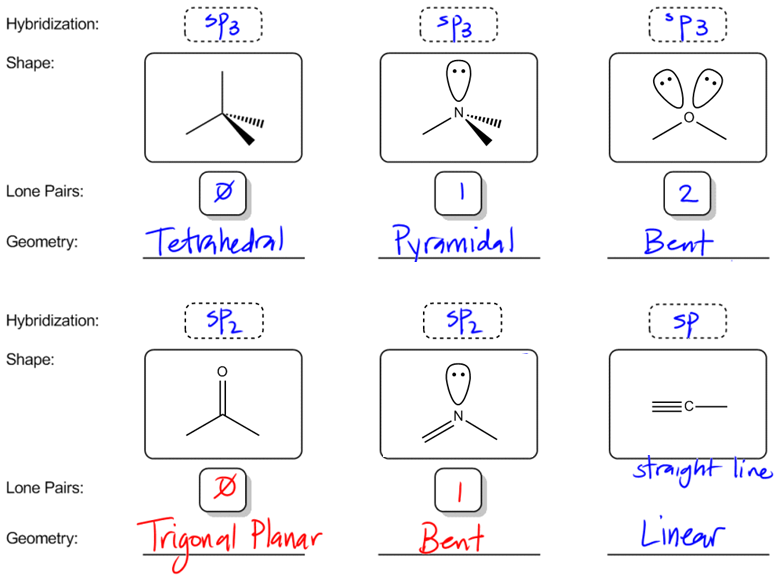
To determine the hybridization of a molecule, one must identify the number of bond sites, which include both atoms and lone pairs of electrons. For example, if a molecule has four bond sites, it is classified as sp3 hybridized. The geometry associated with sp3 hybridization varies based on the presence of lone pairs. A molecule with zero lone pairs adopts a tetrahedral shape, while one with one lone pair takes on a trigonal pyramidal shape, and two lone pairs result in a bent geometry.
For sp2 hybridization, which occurs when there are three bond sites, the geometry can also differ. A molecule with no lone pairs is described as trigonal planar, where all atoms lie in the same plane. If there is one lone pair, the shape may be referred to as bent, although some educators may still classify it as trigonal planar. This highlights the importance of understanding the context in which these terms are used.
Lastly, sp hybridization is characterized by two bond sites, resulting in a linear geometry. This is particularly relevant for molecules with triple bonds, which must be represented in a straight line to accurately reflect their 180-degree bond angle.
In summary, understanding the relationship between hybridization and molecular geometry is essential for predicting the shapes of molecules. By applying VSEPR theory and recognizing the significance of lone pairs, one can effectively determine the geometry of various molecular structures.