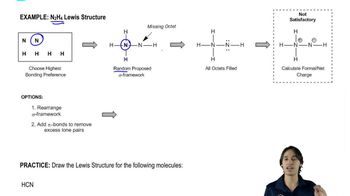
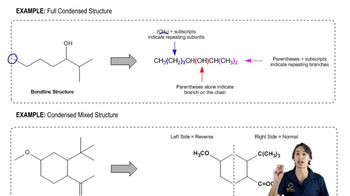
Draw complete Lewis structures for the following condensed structural formulas. (d) CH2CHCHO (e) (CH3)3CCOCHCH2
Verified step by step guidance
1
Identify the functional groups and connectivity in the condensed structural formula. The formula CH2CHCHO(CH3)3CCOCHCH2 suggests the presence of alkenes, carbonyl groups, and possibly branching due to the (CH3)3 group.
Start by drawing the main carbon chain. The sequence CH2CHCHO indicates a chain of three carbon atoms with a double bond between the first and second carbon atoms (CH2=CH) and a carbonyl group (C=O) on the third carbon.
Add the branching group (CH3)3C. This indicates a tertiary butyl group, which is a central carbon atom bonded to three methyl groups. Attach this group to the appropriate carbon in the main chain, likely the carbonyl carbon based on typical structural conventions.
Incorporate the remaining part of the structure, CCOCHCH2. This suggests a continuation of the carbon chain with a carbonyl group (C=O) followed by a double bond (CH=CH2). Ensure that all carbons have four bonds, using hydrogen atoms to satisfy any remaining valencies.
Verify the structure by counting the total number of carbon, hydrogen, and oxygen atoms to ensure they match the original condensed formula. Check for any formal charges and adjust lone pairs or bonds as necessary to complete the Lewis structure.
Verified video answer for a similar problem:
This video solution was recommended by our tutors as helpful for the problem above
Video duration:
4m
Play a video:
0 Comments
Key Concepts
Here are the essential concepts you must grasp in order to answer the question correctly.
Lewis Structures
Lewis structures are diagrams that represent the bonding between atoms of a molecule and the lone pairs of electrons that may exist. They are essential for visualizing the arrangement of atoms, the distribution of electrons, and the connectivity within a molecule. Understanding how to draw Lewis structures involves knowing the valence electrons for each atom and how they share or transfer electrons to form bonds.
Condensed structural formulas are a shorthand way of representing the molecular structure of a compound. They show the arrangement of atoms in a molecule without explicitly depicting all the bonds. Interpreting these formulas requires recognizing groups of atoms and understanding how they are connected, which is crucial for converting them into full Lewis structures.
Functional groups are specific groups of atoms within molecules that have characteristic properties and reactivity. Recognizing functional groups such as carbonyls (C=O) or alkenes (C=C) in a condensed formula helps in predicting the molecule's behavior and drawing accurate Lewis structures. They are key to understanding the chemical properties and reactions of organic compounds.