

Change the following condensed structures to Kekulé structures: a. CH3NH(CH2)2CH3 b. (CH3)2CHCl
Verified step by step guidance
1
Step 1: Understand the problem. The goal is to convert condensed structures into Kekulé structures, which are detailed representations showing all bonds explicitly, including single, double, and triple bonds, as well as lone pairs where applicable.
Step 2: For part (a), CH3NH(CH2)2CH3: Start by identifying the functional groups and connectivity. The molecule contains a methyl group (CH3), an amine group (NH), two methylene groups ((CH2)2), and another methyl group (CH3). Arrange these groups in a linear chain with explicit bonds.
Step 3: Draw the Kekulé structure for part (a). Begin with the central chain: CH3-NH-CH2-CH2-CH3. Represent all single bonds explicitly between the atoms, and show the lone pair on the nitrogen atom in the amine group.
Step 4: For part (b), (CH3)2CHCl: Identify the functional groups and connectivity. The molecule contains two methyl groups (CH3), a central carbon atom (C), and a chlorine atom (Cl). The central carbon is bonded to the two methyl groups and the chlorine atom.
Step 5: Draw the Kekulé structure for part (b). Represent the central carbon atom bonded to two methyl groups and one chlorine atom explicitly. Show all single bonds and the lone pairs on the chlorine atom.
Verified video answer for a similar problem:
This video solution was recommended by our tutors as helpful for the problem above
Video duration:
7m
Play a video:
0 Comments
Key Concepts
Here are the essential concepts you must grasp in order to answer the question correctly.
Kekulé Structures
Kekulé structures are a way of representing organic molecules, particularly aromatic compounds, using lines to depict bonds between atoms. In these structures, carbon atoms are typically shown as vertices of lines, with hydrogen atoms implied. This representation helps visualize the connectivity and arrangement of atoms in a molecule, making it easier to understand its chemical properties and reactivity.
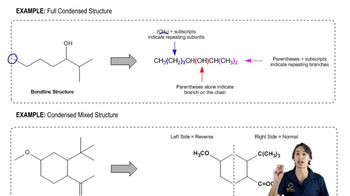
Condensed structural formulas provide a simplified way to represent the structure of a molecule by grouping atoms together. In these formulas, atoms are written in a linear format, often indicating the connectivity without showing all the bonds explicitly. Understanding how to convert these condensed formulas into Kekulé structures is essential for visualizing the three-dimensional arrangement of atoms and the overall molecular geometry.
Functional groups are specific groups of atoms within molecules that are responsible for the characteristic chemical reactions of those molecules. Recognizing functional groups, such as amines or alkyl halides, is crucial when converting condensed structures to Kekulé structures, as they influence the bonding and overall structure of the compound. Identifying these groups helps in predicting the behavior and reactivity of the organic compounds.