How much more stable is the most stable staggered conformer than the most stable eclipsed conformer?
Verified step by step guidance
1
Identify the molecule in question and determine the type of interactions present in both the staggered and eclipsed conformations. For example, in alkanes like ethane, the staggered conformation minimizes torsional strain, while the eclipsed conformation maximizes it.
Understand that the energy difference between staggered and eclipsed conformations arises due to torsional strain. Torsional strain occurs when bonds on adjacent carbons are aligned (eclipsed), leading to repulsion between electron clouds in the bonding orbitals.
Recall that the most stable staggered conformer occurs when bulky groups are positioned as far apart as possible (anti-periplanar), minimizing steric hindrance. The most stable eclipsed conformer occurs when the least sterically hindered groups are aligned.
Use the given or known energy values for the torsional strain of the staggered and eclipsed conformations. For example, in ethane, the energy difference between the staggered and eclipsed conformations is approximately 12 kJ/mol (or 3 kcal/mol).
Calculate the energy difference by subtracting the energy of the most stable staggered conformer from the energy of the most stable eclipsed conformer. This value represents how much more stable the staggered conformer is compared to the eclipsed conformer.
Verified video answer for a similar problem:
This video solution was recommended by our tutors as helpful for the problem above
Video duration:
14m
Play a video:
0 Comments
Key Concepts
Here are the essential concepts you must grasp in order to answer the question correctly.
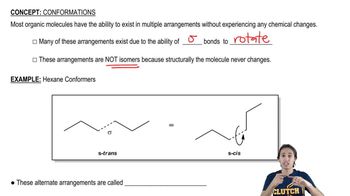
Conformational Isomerism
Conformational isomerism refers to the different spatial arrangements of atoms in a molecule that can be interconverted by rotation around single bonds. In organic chemistry, this concept is crucial for understanding how molecules can adopt various shapes, which significantly influence their stability and reactivity.
Staggered and eclipsed conformers are two specific arrangements of atoms in a molecule, particularly in alkanes. Staggered conformers have groups positioned as far apart as possible, minimizing steric strain, while eclipsed conformers have groups aligned with each other, leading to increased steric hindrance and higher energy states. This difference in arrangement directly affects the stability of the molecule.
The stability of conformers is determined by their potential energy, with lower energy states being more stable. The most stable staggered conformer is significantly lower in energy compared to the most stable eclipsed conformer due to reduced steric interactions. Understanding this energy difference is essential for predicting the behavior and reactivity of organic molecules.