Ch. 8 - Alkenes I: Properties and Electrophilic Additions
Mullins - Organic Chemistry: A Learner Centered Approach 1st Edition
Mullins1st EditionOrganic Chemistry: A Learner Centered ApproachISBN: 9780137566471Not the one you use?Change textbook
Chapter 7, Problem 68c

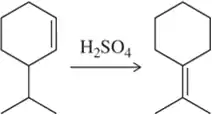
When using sulfuric acid, but in the absence of other nucleophiles like water or bromide ion, less stable alkenes can be isomerized to their more stable isomer. Provide a mechanism for these acid-catalyzed isomerization reactions. [This is one illustration of the principle of microscopic reversibility.]
(c) Illustration of acid-catalyzed isomerization of alkenes using sulfuric acid, showing reactants and products.

Verified step by step guidance
1
Protonation of the alkene: The reaction begins with the alkene reacting with sulfuric acid (H₂SO₄). The π-electrons of the alkene attack the proton (H⁺) from the acid, leading to the formation of a carbocation intermediate. The position of the carbocation depends on the structure of the starting alkene.
Carbocation rearrangement: If the initially formed carbocation is not the most stable one, it can undergo a rearrangement. This rearrangement could involve a hydride shift or an alkyl shift to form a more stable carbocation (e.g., tertiary carbocations are more stable than secondary or primary carbocations).
Deprotonation to form a new alkene: Once the most stable carbocation is formed, a base (such as the bisulfate ion, HSO₄⁻, from sulfuric acid) abstracts a proton (H⁺) from a β-carbon adjacent to the carbocation. This results in the formation of a new π-bond, yielding a more stable alkene.
Microscopic reversibility: The principle of microscopic reversibility ensures that the forward and reverse reactions proceed through the same intermediates. This means that the less stable alkene can isomerize to the more stable alkene via the same carbocation intermediate.
Repeat the process if necessary: If the newly formed alkene is not the most stable isomer, the process can repeat until the thermodynamically most stable alkene is obtained. This stability is typically determined by factors such as the degree of substitution (more substituted alkenes are more stable) and conjugation.

Verified video answer for a similar problem:

This video solution was recommended by our tutors as helpful for the problem above.
Video duration:
3m
Was this helpful?

Key Concepts

Here are the essential concepts you must grasp in order to answer the question correctly.

Acid-Catalyzed Isomerization

Acid-catalyzed isomerization involves the rearrangement of molecular structures under acidic conditions, typically facilitated by protonation of a double bond. This process allows less stable alkenes to convert into more stable isomers by overcoming energy barriers through the formation of carbocations, which can then rearrange to achieve a more favorable configuration.
Recommended video:
Guided course
03:09
Acid Catalyzed

Microscopic Reversibility

Microscopic reversibility is a principle stating that the mechanism of a reaction can be reversed at the molecular level. In the context of acid-catalyzed isomerization, this means that the steps leading to the formation of a product can be retraced to regenerate the reactants, highlighting the dynamic nature of chemical equilibria and the interconversion of isomers.
Recommended video:
Guided course
07:37
Properties and Types of Pericyclic Reactions

Carbocation Stability

Carbocation stability is a key factor in determining the outcome of reactions involving alkenes. Carbocations are positively charged intermediates that can vary in stability based on their structure; tertiary carbocations are more stable than secondary or primary ones due to hyperconjugation and inductive effects. Understanding this stability is crucial for predicting the favored isomerization pathways in acid-catalyzed reactions.
Recommended video:
Guided course
05:58
Determining Carbocation Stability
Related Practice
Textbook Question

Because of the angle strain present in cyclopropanes, they tend to open up in the presence of nearby radicals. Show a mechanism for the following reaction that demonstrates this principle.

1080
views

Textbook Question

When using sulfuric acid, but in the absence of other nucleophiles like water or bromide ion, less stable alkenes can be isomerized to their more stable isomer. Provide a mechanism for these acid-catalyzed isomerization reactions. [This is one illustration of the principle of microscopic reversibility.]

(b)

795
views
Textbook Question

Predict the product of each of the following hydroboration–oxidation or oxymercuration–reduction reactions used in the modern synthetic organic chemistry literature (modified to use reagents we are used to seeing).

(b) A two-step hydroboration–oxidation was used to prepare a silanediol peptidomimetic as a serine protease inhibitor (Org. Lett. 2012, 14, 4422–4425).

1022
views
Textbook Question

Predict the product of each of the following hydroboration–oxidation or oxymercuration–reduction reactions used in the modern synthetic organic chemistry literature (modified to use reagents we are used to seeing).

(c) A similar sequence was featured in the synthesis of muricadienin, a proposed precursor in the biosynthesis of solamin (Org. Lett. 2014, 16, 5886–5889).

834
views
Textbook Question

When using sulfuric acid, but in the absence of other nucleophiles like water or bromide ion, less stable alkenes can be isomerized to their more stable isomer. Provide a mechanism for these acid-catalyzed isomerization reactions. [This is one illustration of the principle of microscopic reversibility.]

(a)

1125
views
Textbook Question

If you react carvone with a single equivalent of HBr, only one product is produced, even though carvone has two carbon–carbon double bonds. Explain this observation.

1488
views