Show how you would accomplish the following synthetic transformations. Show all intermediates. e. 2,2-dibromohexane → hex-1-yne
Verified step by step guidance
1
Step 1: Analyze the starting material, 2,2-dibromohexane. This compound has two bromine atoms attached to the second carbon of a hexane chain. The goal is to convert this into hex-1-yne, which is an alkyne with a triple bond between the first and second carbons.
Step 2: Recognize that the transformation involves elimination reactions to remove the bromine atoms and form a triple bond. This typically requires a strong base to facilitate the elimination process.
Step 3: Use a strong base such as sodium amide (NaNH₂) in liquid ammonia (NH₃) to perform a double elimination. Sodium amide is effective in removing both bromine atoms and generating the alkyne.
Step 4: The first elimination will remove one bromine atom and a hydrogen atom from the adjacent carbon, forming a double bond (an alkene intermediate). The second elimination will remove the remaining bromine atom and another hydrogen atom, forming the triple bond (hex-1-yne).
Step 5: Ensure the reaction conditions are controlled to favor the formation of the terminal alkyne (hex-1-yne). This can be achieved by using excess sodium amide and maintaining the reaction in liquid ammonia.
Verified video answer for a similar problem:
This video solution was recommended by our tutors as helpful for the problem above
Video duration:
8m
Play a video:
0 Comments
Key Concepts
Here are the essential concepts you must grasp in order to answer the question correctly.
Elimination Reactions
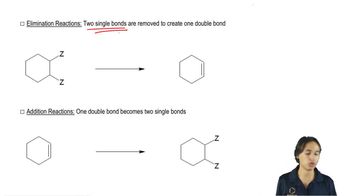
Elimination reactions involve the removal of atoms or groups from a molecule, resulting in the formation of a double or triple bond. In the transformation from 2,2-dibromohexane to hex-1-yne, elimination reactions are crucial as they help in the sequential removal of bromine atoms, leading to the formation of the alkyne. Understanding the mechanism of elimination, such as E2 or E1, is essential for predicting the formation of the desired product.
Alkyne synthesis refers to the methods used to create alkynes, which are hydrocarbons containing a carbon-carbon triple bond. In this case, converting 2,2-dibromohexane to hex-1-yne involves multiple steps, including the formation of a double bond followed by further elimination to achieve the triple bond. Familiarity with various synthetic routes, such as dehydrohalogenation, is necessary for successful alkyne synthesis.
Understanding reaction mechanisms is vital for predicting the steps involved in a chemical transformation. For the conversion of 2,2-dibromohexane to hex-1-yne, one must consider the intermediates formed during the process, such as alkenes, and the specific conditions that favor elimination over substitution. A clear grasp of mechanisms helps in visualizing the pathway from reactants to products, ensuring accurate representation of all intermediates.