Predict the major products formed when benzene reacts (just once) with the following reagents. a. tert-butyl bromide, AlCl3 b. 1-chlorobutane, AlCl3
Verified step by step guidance
1
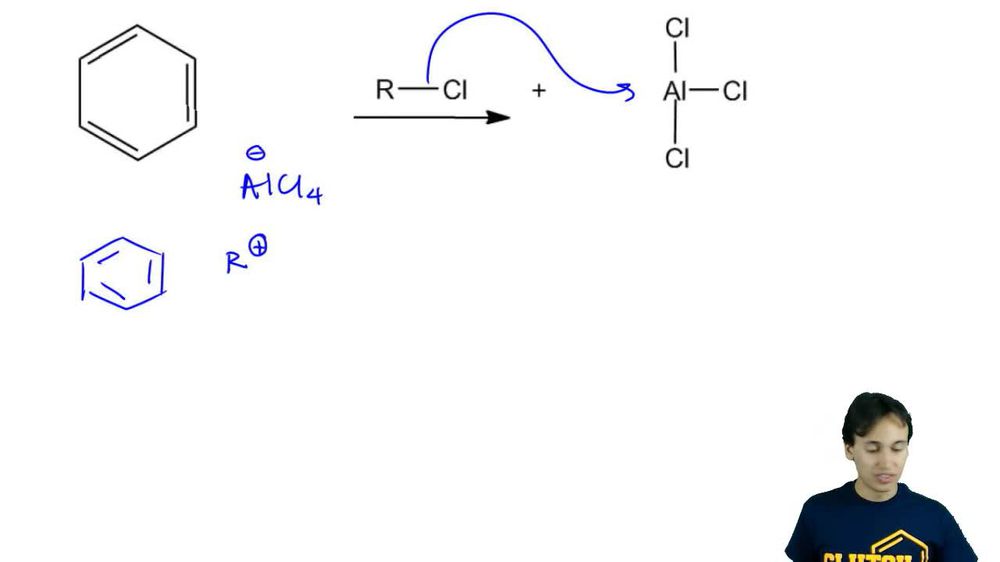
Step 1: Recognize that the reaction involves benzene and an alkyl halide in the presence of AlCl₃, which is a Friedel-Crafts alkylation reaction. This reaction introduces an alkyl group onto the benzene ring.
Step 2: For part (a), tert-butyl bromide (C(CH₃)₃Br) reacts with AlCl₃ to form a tert-butyl carbocation (C(CH₃)₃⁺) as the electrophile. This occurs because AlCl₃ acts as a Lewis acid, abstracting the bromide ion (Br⁻) from tert-butyl bromide.
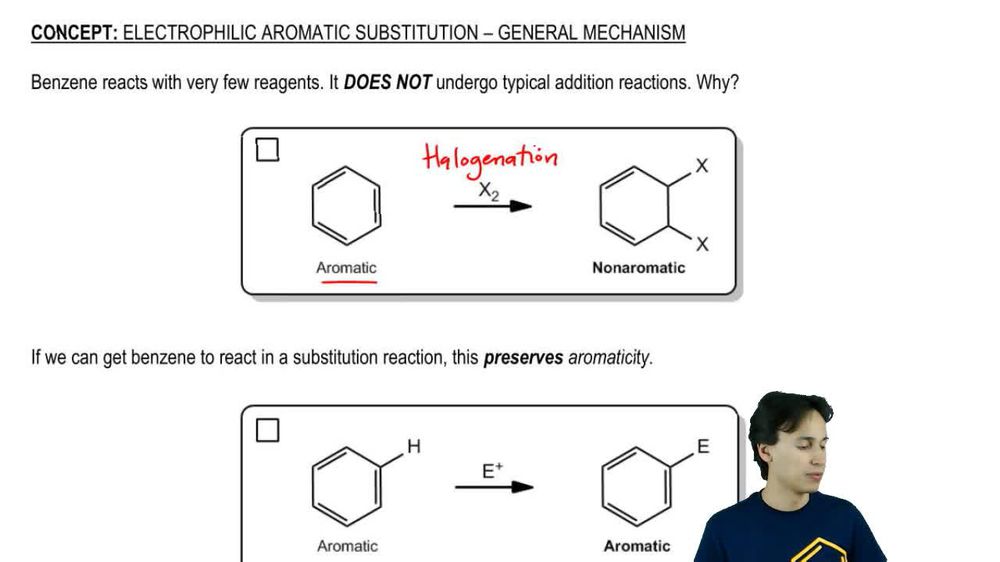
Step 3: The tert-butyl carbocation then reacts with the benzene ring via electrophilic aromatic substitution. The π-electrons of the benzene ring attack the carbocation, forming a sigma complex (arenium ion). This intermediate is stabilized by resonance.
Step 4: The sigma complex loses a proton (H⁺) to restore aromaticity, resulting in the formation of tert-butylbenzene as the major product.
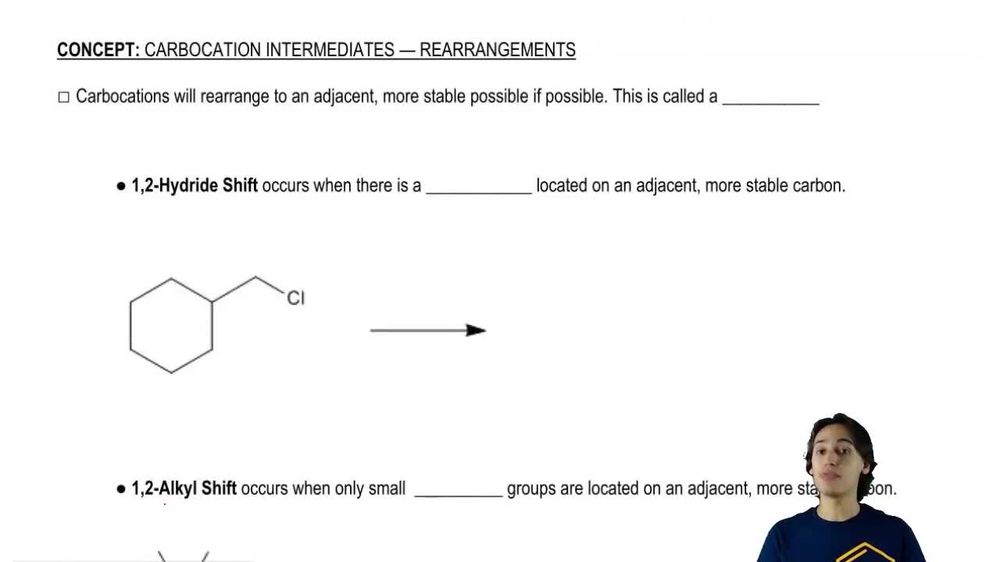
Step 5: For part (b), 1-chlorobutane (CH₃CH₂CH₂CH₂Cl) reacts with AlCl₃ to form a primary butyl carbocation (CH₃CH₂CH₂CH₂⁺). However, primary carbocations are unstable and undergo hydride shifts to form a more stable secondary carbocation (CH₃CH₂CH⁺CH₃). This secondary carbocation then reacts with benzene in the same manner as described in steps 3 and 4, leading to the formation of sec-butylbenzene as the major product.
Verified video answer for a similar problem:
This video solution was recommended by our tutors as helpful for the problem above
Video duration:
4m
Play a video:
0 Comments
Key Concepts
Here are the essential concepts you must grasp in order to answer the question correctly.
Electrophilic Aromatic Substitution
Electrophilic aromatic substitution (EAS) is a fundamental reaction in organic chemistry where an electrophile replaces a hydrogen atom on an aromatic ring. This process is crucial for understanding how benzene and its derivatives react with various reagents, as it preserves the aromaticity of the ring while introducing new substituents.
Friedel-Crafts alkylation is a specific type of electrophilic aromatic substitution that involves the introduction of an alkyl group onto an aromatic ring using an alkyl halide and a Lewis acid catalyst, such as AlCl3. This reaction can lead to the formation of branched or linear alkyl groups, depending on the structure of the alkyl halide used.
The stability and rearrangement of carbocations play a critical role in reactions involving alkyl halides. When an alkyl halide reacts in a Friedel-Crafts alkylation, the formation of a carbocation intermediate can lead to rearrangements, resulting in more stable carbocations, which can affect the final product distribution.