Step 1: Recognize the reaction type. Both reactions involve Friedel-Crafts alkylation, where an alkyl halide reacts with benzene in the presence of AlCl₃, a Lewis acid catalyst. This reaction introduces an alkyl group onto the benzene ring.
Step 2: Analyze the first reaction (a). The alkyl halide is 2-chloropropane. AlCl₃ will abstract the chlorine atom, generating a secondary carbocation (CH₃-CH⁺-CH₃). This carbocation will act as the electrophile and attack the benzene ring, forming an alkylbenzene product.
Step 3: Analyze the second reaction (b). The alkyl halide is 1-chloro-2-cyclopentylpropane. AlCl₃ will abstract the chlorine atom, generating a carbocation. Due to the hint provided, hydride shifts and ring expansions are expected. A hydride shift will stabilize the carbocation, and a ring expansion will occur to form a more stable six-membered ring carbocation.
Step 4: Predict the products for reaction (b). After the rearrangements (hydride shift and ring expansion), the stabilized carbocation will attack the benzene ring, forming two possible alkylbenzene products based on the rearranged carbocation structures.
Step 5: Summarize the mechanism. Both reactions proceed via carbocation formation, electrophilic attack on benzene, and stabilization of the intermediate. For reaction (b), rearrangements (hydride shift and ring expansion) lead to two distinct products. Ensure to draw the final products to visualize the structures.
Verified video answer for a similar problem:
This video solution was recommended by our tutors as helpful for the problem above
Video duration:
5m
Play a video:
0 Comments
Key Concepts
Here are the essential concepts you must grasp in order to answer the question correctly.
Electrophilic Aromatic Substitution
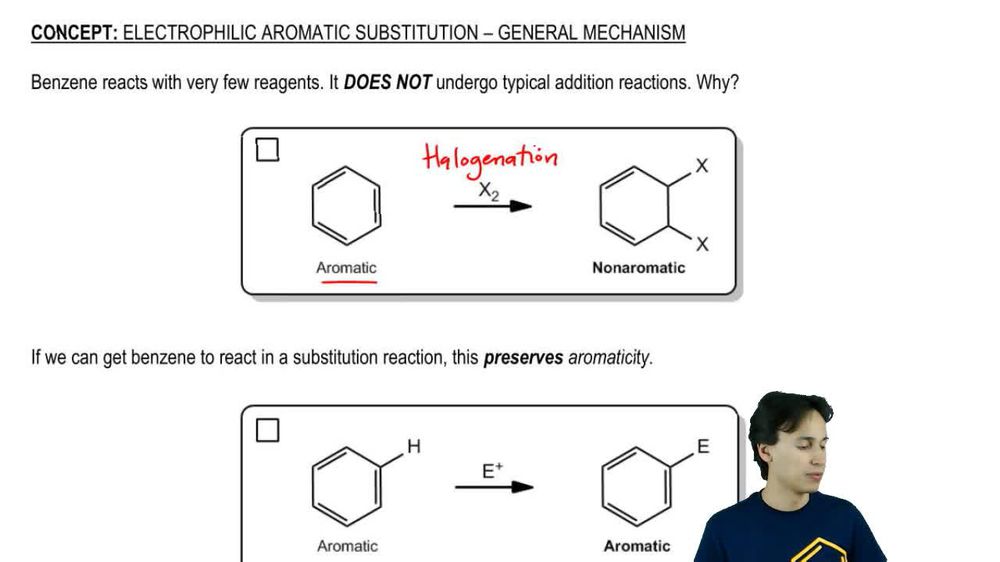
Electrophilic aromatic substitution (EAS) is a fundamental reaction in organic chemistry where an electrophile replaces a hydrogen atom on an aromatic ring. In this process, the aromatic system retains its stability while allowing for the introduction of new substituents. The presence of a strong electrophile, such as a chlorinated compound in the presence of a Lewis acid catalyst like AlCl3, is crucial for facilitating this reaction.
Lewis acids are substances that can accept an electron pair from a Lewis base to form a coordinate covalent bond. In the context of EAS, AlCl3 acts as a Lewis acid that activates the chlorinated compound, making it a more potent electrophile. This activation is essential for the reaction to proceed, as it enhances the electrophilic character of the chlorinated species, allowing it to effectively react with the aromatic ring.
In some electrophilic aromatic substitution reactions, the products can undergo rearrangement to form more stable structures. This is particularly relevant when the electrophile is a carbocation, which can shift to form a more stable tertiary or secondary carbocation. Understanding the stability of potential carbocation intermediates is key to predicting the final products of the reaction, as it influences the outcome and the types of substituents that can be formed.