Predict the major products formed when benzene reacts (just once) with the following reagents. c. isobutyl alcohol + BF3
Verified step by step guidance
1
Step 1: Recognize the type of reaction. This reaction involves benzene and isobutyl alcohol in the presence of BF₃ (boron trifluoride). BF₃ is a Lewis acid, which can facilitate the formation of a carbocation from isobutyl alcohol. This suggests that the reaction will proceed via an electrophilic aromatic substitution (EAS) mechanism.
Step 2: Generate the electrophile. BF₃ interacts with isobutyl alcohol to form a carbocation. The hydroxyl group (-OH) of isobutyl alcohol is protonated and leaves as water, resulting in the formation of a tertiary carbocation: (CH₃)₂CH⁺CH₂⁺.
Step 3: Identify the site of attack. Benzene, being electron-rich, will act as a nucleophile and attack the carbocation. This forms a sigma complex (also called an arenium ion), where the benzene ring temporarily loses aromaticity.
Step 4: Restore aromaticity. A proton (H⁺) is removed from the sigma complex by a base (often the BF₄⁻ counterion or another molecule in the reaction mixture), restoring the aromaticity of the benzene ring. The final product is an alkylbenzene, where the isobutyl group is attached to the benzene ring.
Step 5: Predict the major product. Since the isobutyl carbocation is relatively stable due to hyperconjugation and inductive effects, the major product will be isobutylbenzene, where the isobutyl group is directly bonded to the benzene ring.
Verified video answer for a similar problem:
This video solution was recommended by our tutors as helpful for the problem above
Video duration:
5m
Play a video:
0 Comments
Key Concepts
Here are the essential concepts you must grasp in order to answer the question correctly.
Electrophilic Aromatic Substitution
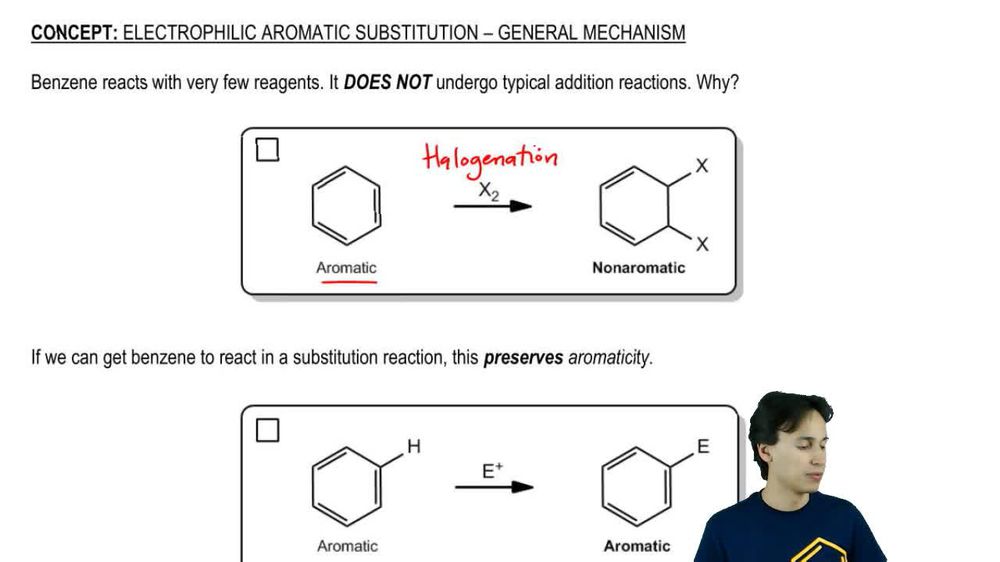
Electrophilic aromatic substitution (EAS) is a fundamental reaction mechanism in organic chemistry where an electrophile replaces a hydrogen atom on an aromatic ring. In this process, the aromatic system donates electrons to the electrophile, forming a sigma complex, which then loses a proton to restore aromaticity. Understanding EAS is crucial for predicting the products of reactions involving benzene and electrophiles.
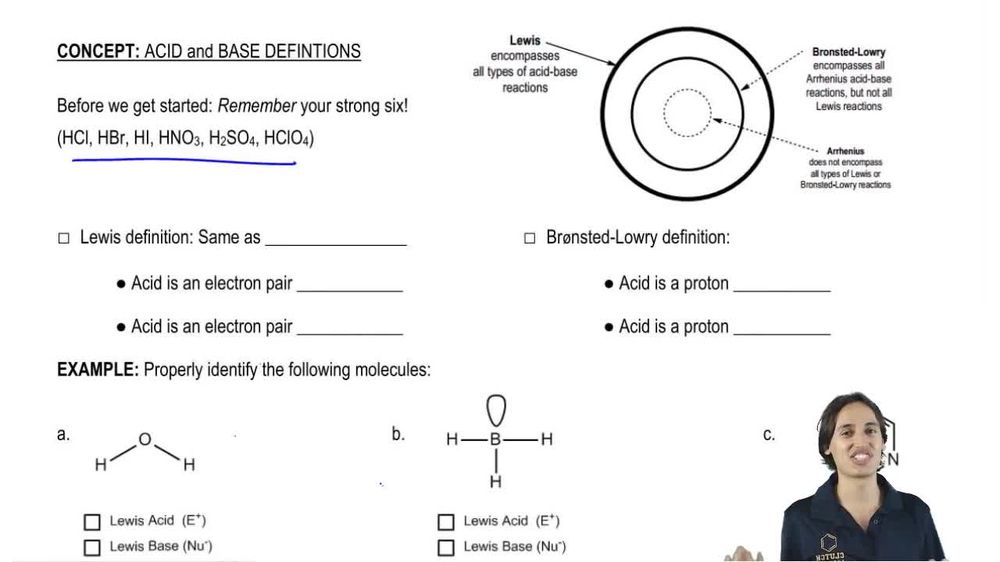
Lewis acids are species that can accept an electron pair, while Lewis bases are those that can donate an electron pair. In the context of the reaction with isobutyl alcohol and BF3, BF3 acts as a Lewis acid, facilitating the formation of a more reactive electrophile. Recognizing the roles of Lewis acids and bases is essential for understanding how they influence reaction pathways and product formation.
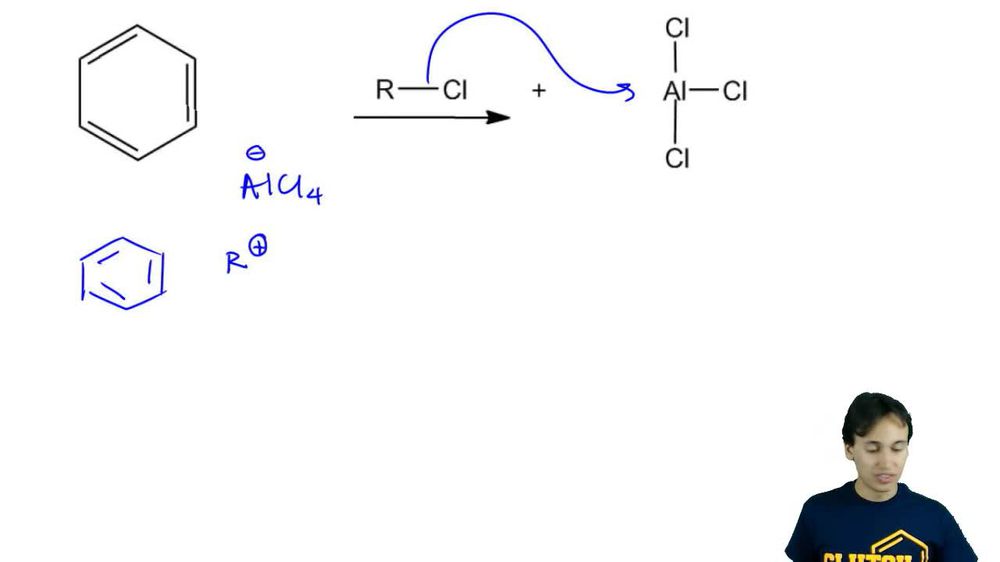
Friedel-Crafts alkylation is a specific type of electrophilic aromatic substitution where an alkyl group is introduced to an aromatic ring using a Lewis acid catalyst. In this case, the isobutyl group from isobutyl alcohol can be transferred to the benzene ring in the presence of BF3. This concept is vital for predicting the structure of the major product formed in the reaction.