What is the major product of each of the following reactions? d.
Verified step by step guidance
1
Step 1: Analyze the starting material. The given compound is a cyclopentanol, which contains a hydroxyl (-OH) group attached to a cyclopentane ring. The reaction involves HCl, a strong acid.
Step 2: Understand the reaction mechanism. When alcohols react with HCl, the hydroxyl group is protonated by HCl, forming water as a leaving group. This step increases the electrophilicity of the carbon attached to the hydroxyl group.
Step 3: Consider the formation of a carbocation intermediate. After the water leaves, a carbocation is formed at the carbon where the hydroxyl group was attached. Evaluate the stability of the carbocation. In this case, the carbocation is secondary, which is relatively stable.
Step 4: Predict the nucleophilic attack. The chloride ion (Cl⁻) from HCl will act as a nucleophile and attack the carbocation, forming a new C-Cl bond.
Step 5: Determine the major product. The major product will be the cyclopentane ring with a chlorine atom attached to the carbon where the hydroxyl group was originally located.
Verified video answer for a similar problem:
This video solution was recommended by our tutors as helpful for the problem above
Video duration:
3m
Play a video:
0 Comments
Key Concepts
Here are the essential concepts you must grasp in order to answer the question correctly.
Electrophilic Addition
Electrophilic addition is a fundamental reaction mechanism in organic chemistry where an electrophile reacts with a nucleophile, resulting in the formation of a more saturated product. In the context of the given reaction, HCl acts as the electrophile, adding across the double bond of the cyclic compound, which contains an alcohol group. Understanding this mechanism is crucial for predicting the major product formed.
Markovnikov's Rule states that in the addition of HX (where X is a halogen) to an alkene, the hydrogen atom will attach to the carbon with the greater number of hydrogen atoms already attached. This principle helps predict the regioselectivity of the reaction, guiding us to determine which carbon will bond with the chlorine from HCl in the reaction shown, leading to the major product.
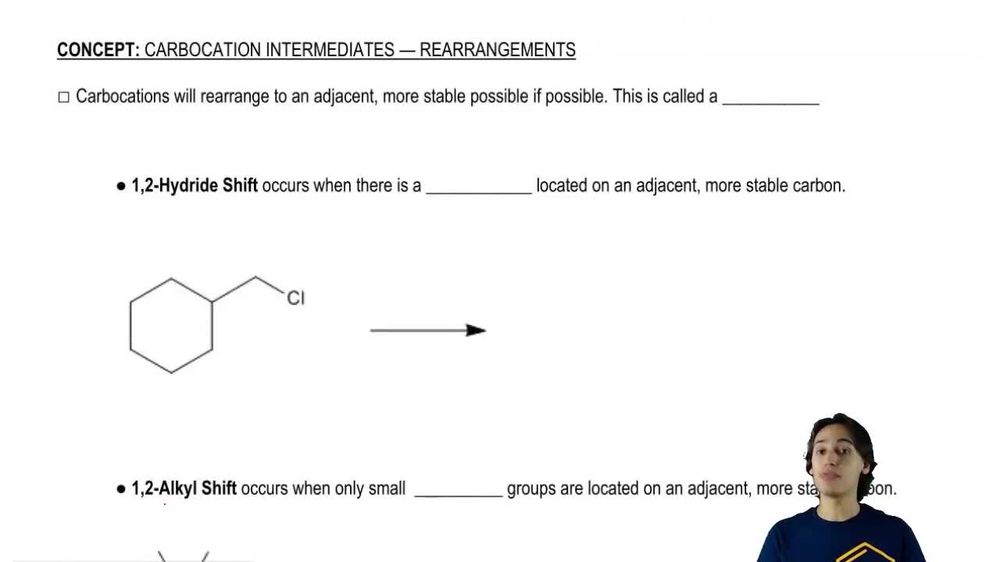
Carbocation rearrangement is a process where a carbocation (positively charged carbon species) can shift its structure to form a more stable carbocation during a reaction. In the reaction depicted, if a carbocation intermediate is formed, it may rearrange to a more stable form before the final product is produced. Recognizing the potential for rearrangement is essential for accurately predicting the major product of the reaction.

 3:46 minutes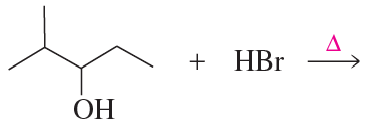
 Verified step by step guidance
 09:23
09:23