What is the major product of each of the following reactions? b.
Verified step by step guidance
1
Step 1: Analyze the structure of the starting material. The molecule is a cyclohexane ring with a hydroxyl (-OH) group attached to a tertiary carbon. This tertiary carbon is also bonded to two methyl groups.
Step 2: Recognize the reagent used in the reaction. HBr is a strong acid that can protonate the hydroxyl group, converting it into a good leaving group (water). This sets the stage for a substitution reaction.
Step 3: Protonation of the hydroxyl group occurs first. The oxygen in the -OH group will accept a proton (H⁺) from HBr, forming H₂O as a leaving group.
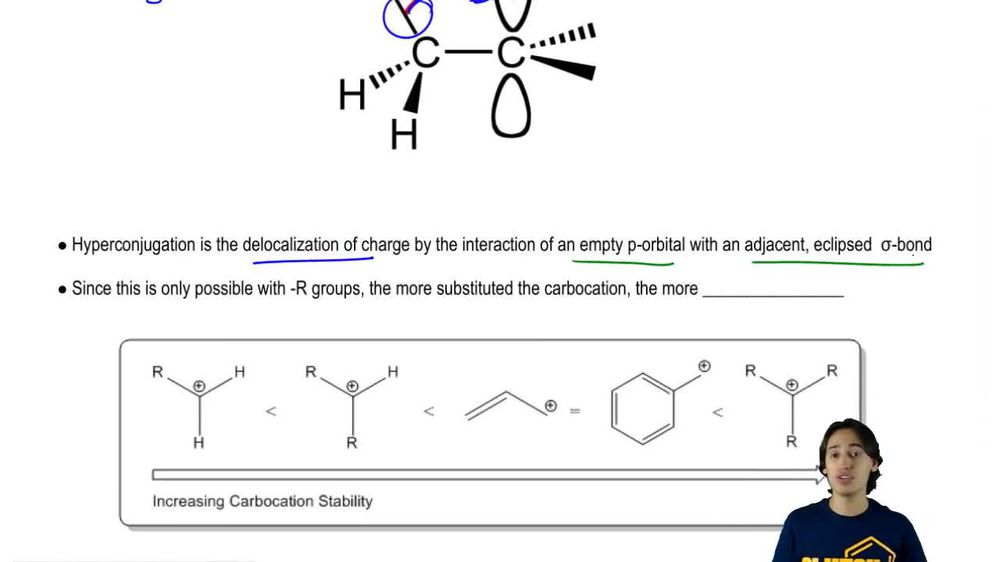
Step 4: After the leaving group departs, a carbocation intermediate is formed. Since the hydroxyl group is attached to a tertiary carbon, the resulting carbocation is tertiary, which is highly stable due to hyperconjugation and inductive effects.
Step 5: The bromide ion (Br⁻) from HBr will act as a nucleophile and attack the carbocation, resulting in the formation of the major product, which is a tertiary alkyl bromide.
Verified video answer for a similar problem:
This video solution was recommended by our tutors as helpful for the problem above
Video duration:
3m
Play a video:
0 Comments
Key Concepts
Here are the essential concepts you must grasp in order to answer the question correctly.
Nucleophilic Substitution
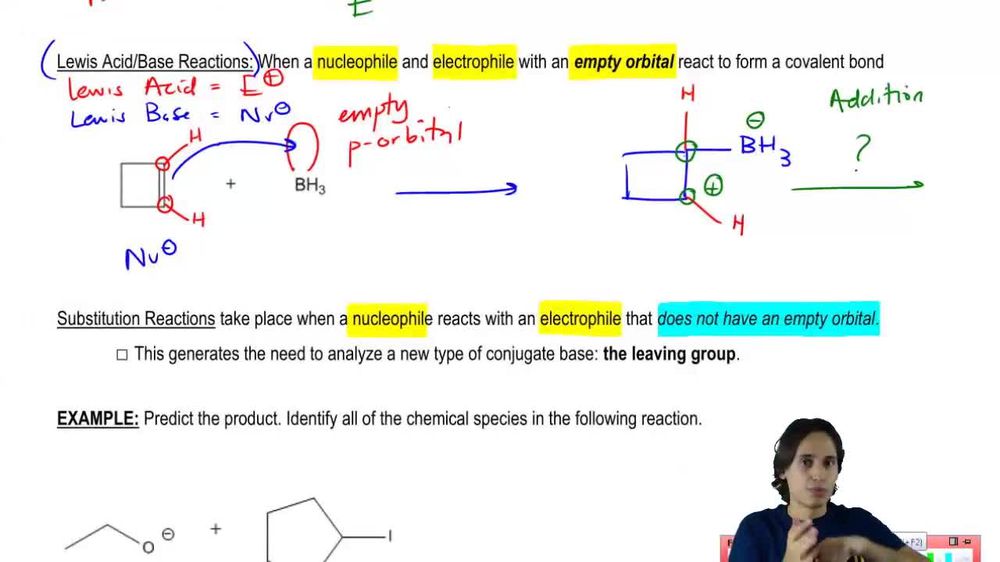
Nucleophilic substitution is a fundamental reaction mechanism in organic chemistry where a nucleophile replaces a leaving group in a molecule. In the case of alcohols reacting with hydrogen halides like HBr, the hydroxyl group (-OH) is converted into a better leaving group, allowing the bromide ion (Br-) to attach to the carbon atom, forming an alkyl bromide.
Nucleophiles and Electrophiles can react in Substitution Reactions.
Carbocation Stability
Carbocation stability is crucial in determining the outcome of reactions involving alcohols and hydrogen halides. The stability of the carbocation intermediate formed during the reaction influences the major product. Tertiary carbocations are more stable than secondary or primary ones, leading to preferential formation of products that arise from more stable carbocations.
Markovnikov's Rule states that in the addition of HX (where X is a halogen) to an alkene or an alcohol, the hydrogen atom will attach to the carbon with the greater number of hydrogen atoms already attached. This rule helps predict the major product of the reaction, guiding the formation of the more stable alkyl halide product when cyclohexanol reacts with HBr.

 3:17 minutes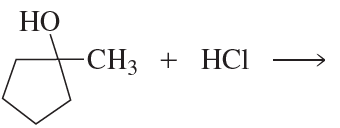
 Verified step by step guidance
 01:47
01:47