What is the major product of each of the following reactions? c.
Verified step by step guidance
1
Step 1: Analyze the starting material. The given compound is a cyclohexanol derivative with a tertiary alcohol group attached to the cyclohexane ring. The reaction involves HCl, which suggests an acid-catalyzed substitution reaction.
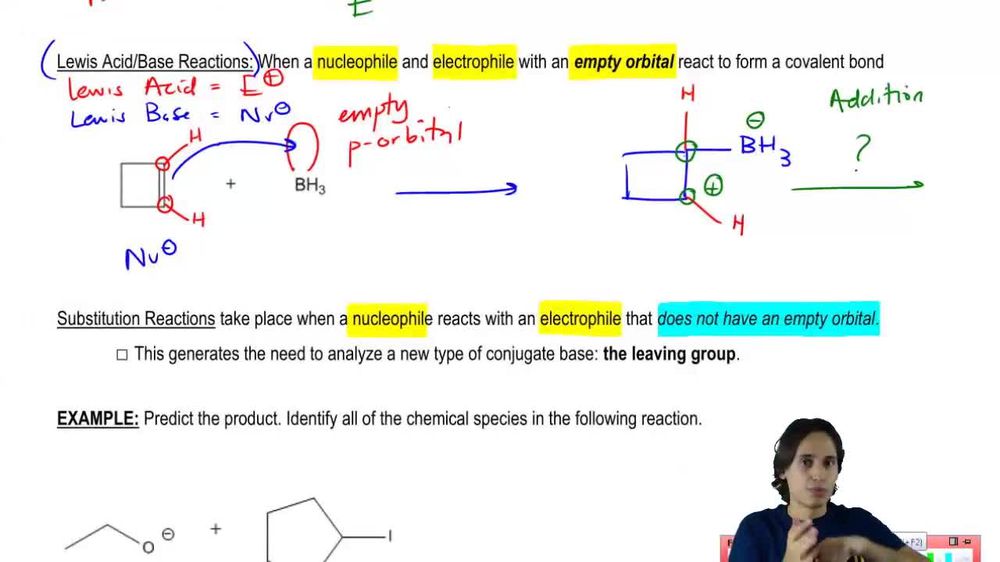
Step 2: Understand the mechanism. In the presence of HCl, the hydroxyl group (-OH) will be protonated to form water (H2O), which is a good leaving group. This step facilitates the formation of a carbocation intermediate.
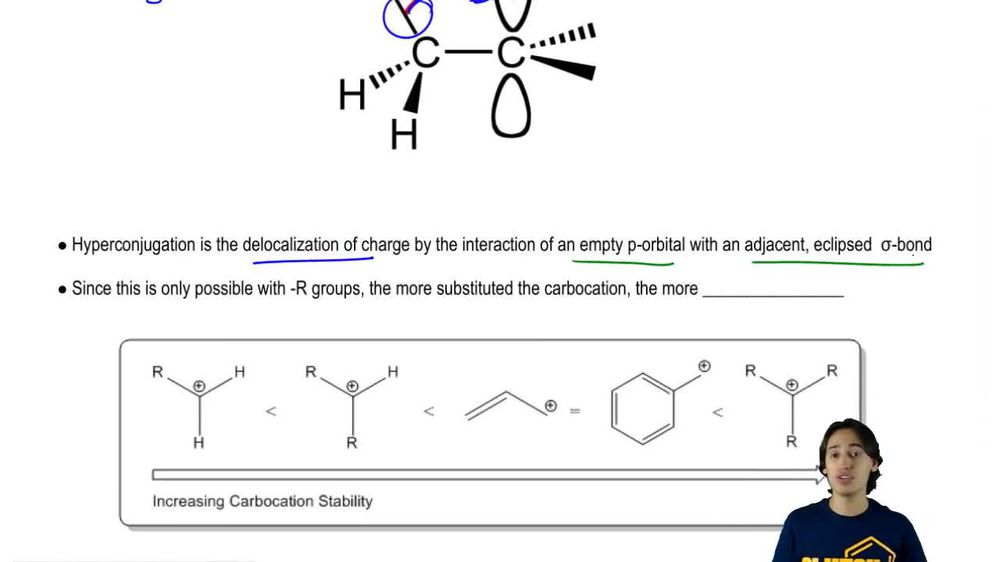
Step 3: Consider carbocation stability. The carbocation formed after the departure of water will be a tertiary carbocation, which is highly stable due to hyperconjugation and inductive effects from the adjacent alkyl groups.
Step 4: Predict the nucleophilic attack. The chloride ion (Cl⁻) from HCl will act as a nucleophile and attack the carbocation, leading to the formation of the major product.
Step 5: Conclude the major product. The major product will be a tertiary alkyl chloride, where the hydroxyl group is replaced by a chlorine atom at the same position.
Verified video answer for a similar problem:
This video solution was recommended by our tutors as helpful for the problem above
Video duration:
4m
Play a video:
0 Comments
Key Concepts
Here are the essential concepts you must grasp in order to answer the question correctly.
Acid-Base Reactions
In organic chemistry, acid-base reactions involve the transfer of protons (H+) between molecules. In this case, HCl acts as a strong acid, donating a proton to the hydroxyl group (-OH) of cyclohexanol, which leads to the formation of a better leaving group, water. Understanding this concept is crucial for predicting the outcome of reactions involving alcohols and acids.
The formation of carbocations is a key step in many organic reactions, including the reaction of alcohols with acids. The stability of the carbocation intermediate influences the major product formed. Tertiary carbocations are more stable than secondary or primary ones, so the reaction pathway will favor the formation of the most stable carbocation, which ultimately determines the major product.
Nucleophilic substitution reactions involve the replacement of a leaving group by a nucleophile. In the context of the reaction shown, after protonation of the alcohol, the resulting water molecule leaves, allowing a nucleophile (like chloride ion from HCl) to attack the carbocation. This process is essential for understanding how the final product is formed from the initial reactants.

 4:40 minutes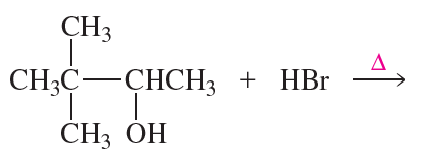
 Verified step by step guidance
 02:49
02:49